
 Q2
Q2
 QIDI Box
 Plus 4
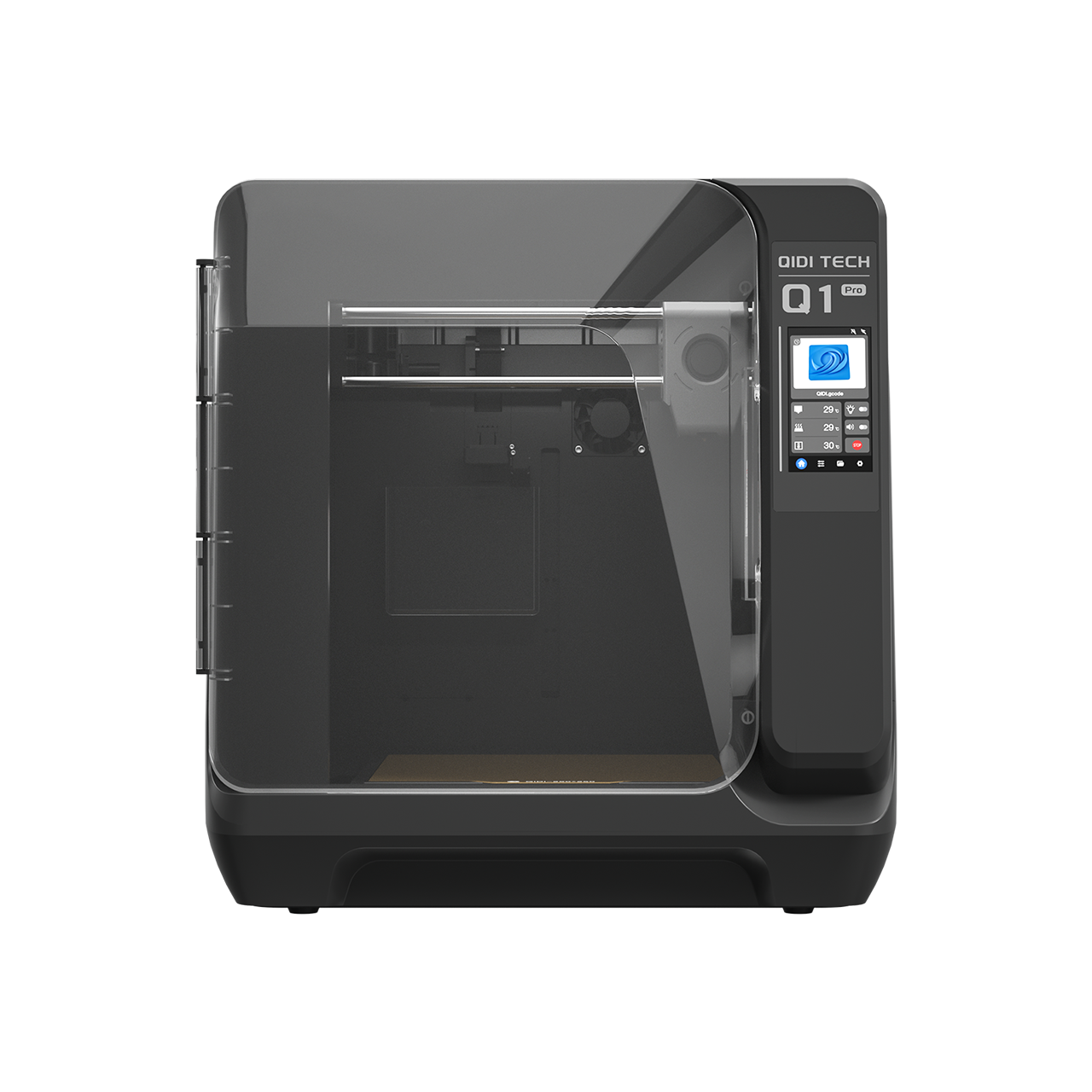 Q1 Pro
 X-Max 3


Is PLA Filament for 3D Printing Toxic?


PLA filament is among the lowest-emitting materials in desktop 3D printing, but it is not emission-free. Chamber tests measured median ultrafine particle emission rates near 100 million particles per minute for PLA, against 20–90 billion per minute for ABS. For most home users the practical risk comes from long prints in small, poorly ventilated rooms.
What Is PLA Filament?
PLA (polylactic acid) is a thermoplastic polyester made from fermented plant starch, usually corn or sugarcane, and it is the most widely used material in desktop FDM 3D printing. It melts at a lower temperature than most engineering plastics, typically extruding between 190°C and 220°C, and it does not require a heated chamber to print without warping.
Two things about that definition matter for safety. The base polymer is not the same thing as the spool you buy: commercial PLA contains colorants, impact modifiers, and processing additives the manufacturer is not required to itemize. And "plant-based" describes the feedstock, not the emissions. Heating any thermoplastic to 200°C produces airborne byproducts. The right question is not whether PLA is toxic in the abstract, but how much of what it releases reaches your lungs under your printing conditions.
How Much Does PLA Actually Emit Compared to Other Filaments?
PLA produced the lowest ultrafine particle emission rate of every filament tested in the most widely cited chamber study of desktop 3D printers. Azimi and colleagues at Illinois Institute of Technology tested five commercially available printers with up to nine filaments in a controlled chamber and reported the results in Environmental Science & Technology. Across all 16 printer-and-filament combinations, median time-varying ultrafine particle (UFP) emission rates spanned roughly 108 to 1011 particles per minute — a thousandfold spread driven almost entirely by material choice.
| Filament | Median UFP emission rate (particles/min) | Dominant individual VOC | That VOC's emission rate |
|---|---|---|---|
| PLA | ~1 × 10⁸ (~100 million) | Lactide | ~4–5 µg/min |
| Nylon | ~2 × 10⁸ | Caprolactam | up to ~180 µg/min |
| HIPS | ~4 × 10⁹ | Styrene | ~12–113 µg/min |
| ABS | ~2 × 10¹⁰ to ~9 × 10¹⁰ | Styrene | ~12–113 µg/min |
| Polycarbonate | ~4 × 10¹⁰ | Caprolactam (lower levels) | not the top emitter |
Read the particle column carefully, because the gap is larger than it looks. ABS printing emitted on the order of 200 to 900 times more ultrafine particles per minute than PLA in the same chamber. That is the single strongest piece of evidence behind the common advice to start with PLA indoors, and it is a real, measured difference rather than a marketing claim. It is also why the ABS versus PLA decision is partly an indoor-air decision, not only a mechanical one.
What the same data does not support is calling PLA clean. 100 million particles per minute is a low number in this comparison and a large number in absolute terms. UL's Chemical Insights research program, which developed the test methods behind the ANSI/CAN/UL 2904 emissions standard, reports that particle emissions from desktop printers can reach up to one trillion particles per hour and that the emitted mixture routinely exceeds 200 distinct volatile organic compounds.
Which Compounds Does PLA Release, and Are They Hazardous?
The dominant VOC from PLA is lactide, the cyclic dimer of lactic acid, emitted at roughly 4–5 µg/min in the Azimi chamber tests. Lactide does not carry the carcinogen classifications that attach to the main ABS byproduct. Styrene, which dominates ABS and HIPS emissions at 12–113 µg/min, is described by the American Lung Association as a possible human carcinogen, alongside formaldehyde as a known human carcinogen and caprolactam as a compound of concern.
So on the VOC axis PLA looks considerably better than ABS, and the difference is chemical, not merely quantitative. On the particle axis the material advantage matters less, because ultrafine particles are a hazard defined by size rather than chemistry. UFPs are airborne particles smaller than 100 nanometers (0.1 micron). At that size they deposit in the deep lung instead of being filtered by the upper airway, and peer-reviewed reviews of ultrafine particle health effects document translocation into the bloodstream.
Two caveats belong here. No published occupational exposure limit exists for desktop 3D printer emissions, so nobody can tell you a number of print-hours that is "within limits." And formulation matters: silk, matte, wood-filled, and glow-in-the-dark blends contain additives that were not part of the tested standard PLA.
Who Should Be More Careful With PLA Printing?
Exposure risk is driven by how long you breathe the air, how much air dilutes the emissions, and how sensitive the airway is — not by the filament alone. The table below sorts the common household situations by how much attention the setup deserves.
| Situation | Attention level | Why |
|---|---|---|
| Adult, occasional short prints, ventilated garage or workshop | Low | Short exposure window, high dilution volume, low occupancy |
| Adult, daily multi-hour prints, home office with a door left open | Moderate | Cumulative exposure rises with print hours per week, not per job |
| Printer in a bedroom, dorm room, or small closed office | High | Sleeping means 6–9 continuous hours in the emission plume with minimal air exchange |
| Children, or a nursery or classroom setting | High | Higher breathing rate relative to body mass and developing airways; ALA advises against operating printers in occupied spaces |
| Anyone with asthma or COPD | High | ALA lists asthma and COPD exacerbation among documented 3D printer emission effects |
| Specialty PLA blends (silk, wood-filled, matte, glow-in-dark) | Unknown, treat as moderate | Additive packages differ from the tested standard PLA; no comparable published emission data |
Notice that the highest-attention rows are all about the room and the person, not the spool. If your printer lives where someone sleeps, changing the filament will not fix that setup. Moving the printer will. If a separate room is not available, the trade-offs are covered in more detail in the guide to home 3D printing safety.
Which Protective Measures Have Measured Evidence Behind Them?
A ventilated enclosure is the single most effective control with published numbers behind it, and a sealed-but-unvented enclosure is one of the weakest. That distinction is the most useful thing in this article, because most hobbyists conflate the two.
| Control | Measured effect | Source | Caveat |
|---|---|---|---|
| Ventilated enclosure (enclosure plus extraction) | 99.7% reduction in particle concentration; 69.5% reduction in TVOC | UL Chemical Insights | Requires the exhaust path to actually leave the room |
| Integrated filtration system | 95% or greater reduction in maximum particle concentration | UL Chemical Insights | Particle capture; VOC capture depends on carbon media and its age |
| Passive enclosure alone, not sealed | ~35% reduction in median UFP emission rate, and within measurement uncertainty | Azimi et al., chamber test | Gaps in the enclosure were visible; treat as containment, not filtration |
| HEPA air cleaner in the room | Effective on particles by filter class; no VOC removal without carbon | US EPA | Sized to room volume; a small unit in a large room does little |
| Lower nozzle temperature | UFP emission rates rose with increasing nozzle temperature at midrange bed temperatures | Azimi et al. | Only usable down to the point where layer adhesion holds |
| Opening a window | Increases air exchange; no quantified reduction for printer emissions | ALA general ventilation advice | Weather-dependent and not a substitute for source control |
Practically, this ranks the upgrades. If you print frequently indoors, an enclosed printer with a real filtration stack does more than any air purifier you place across the room. The Max4, for example, pairs its enclosed chamber with a three-stage filter — G3 pre-filter, H12 HEPA, and coconut-shell activated carbon — which is the layout that addresses particles and VOCs separately rather than hoping one medium handles both. The same logic is unpacked in the article on triple air filtration for home printing. If you are still choosing hardware, the comparison of open versus enclosed printers is worth reading before the printer decision is locked in.
What Nozzle Temperature Keeps PLA Emissions Low?
Print PLA at the lowest nozzle temperature that still gives you clean layer bonding, typically the bottom of the manufacturer's range rather than a round default. In the Azimi chamber tests, UFP emission rates were higher at increased nozzle temperatures once bed temperature was held in the midrange, which makes temperature the one emissions variable you can adjust from the slicer for free.
The method: print a temperature tower, find the lowest temperature that passes a manual bend test without delaminating, and set your profile 5°C above it. Bed temperature deserves a look too, because in the same study the combinations running the highest bed temperatures also showed the highest UFP emission rates. Most PLA beds do not need more than 60°C. If these settings are unfamiliar, start with the print settings primer.
Is PLA Safe to Touch, Sand, or Use for Food Containers?
Handling cured PLA parts is a different exposure route from breathing print emissions, and it carries different answers. Solid PLA at room temperature is stable and is not a respiratory hazard; the spool sitting on your shelf is not the problem this article is about.
Sanding, drilling, and cutting are the exception. Post-processing generates fine plastic dust, which is a mechanical airway irritant regardless of what the polymer is. Use wet sanding or local dust extraction, wipe surfaces down rather than dry-brushing them, and consider basic respiratory protection if you are finishing several parts in one session indoors. There is more detail in the guide to sanding and polishing PLA prints.
Food contact is where the honest answer is least satisfying. The polymer is used in food-contact applications commercially, but an FDM print is not a molded part: layer lines create crevices that are hard to clean and harbor bacteria, and neither the filament's additives nor the brass in a standard nozzle is certified for food contact. Treat printed items as single-use or decorative unless the vendor supplies documentation for that specific spool. Filament data sheets are the starting point, and the filament catalogue is where those specifications live.
Long overnight jobs raise a second, separate question about supervision and fire risk, which is covered in the guide to unattended printing risks. The Plus 4 illustrates why enclosed machines tend to be the ones people leave running: it combines the enclosed chamber with a smart PTC fuse and dual temperature sensors that cut power automatically on abnormal temperatures.
FAQs About PLA Filament Safety
Is PLA filament toxic to breathe?
PLA emits fewer ultrafine particles and a less hazardous dominant VOC than ABS, but it is not emission-free, and no exposure limit has been published for desktop 3D printer emissions. Measured PLA emissions are around 100 million particles per minute with roughly 4–5 µg/min of lactide. In a ventilated space with short prints, that is a low-concern exposure. In a closed bedroom running prints nightly, it is not.
Can I sleep in the same room as a 3D printer running PLA?
It is not recommended. Sleeping puts you in the emission plume for six to nine continuous hours in a room that is usually closed, which is the highest-exposure scenario in a home. The American Lung Association advises against operating printers in occupied spaces and recommends dedicated printing rooms where possible.
Does an enclosure make PLA printing safe?
Only if the enclosure is vented or filtered. In chamber testing, an unsealed passive enclosure reduced median UFP emission rates by about 35%, a result the researchers noted was within measurement uncertainty. A ventilated enclosure, by contrast, has been measured at 99.7% particle reduction. The enclosure is the container; the extraction or filtration is the control.
Is an air purifier enough on its own?
An air purifier helps with particles and is not a complete solution. HEPA media captures particles but does not remove VOCs unless the unit also contains activated carbon, and effectiveness depends on matching the unit's clean air delivery rate to the room volume. Purifiers work best as the last stage after source control, enclosure, and ventilation.
Are silk, matte, and wood-filled PLA the same as regular PLA?
Do not assume so. Those blends contain additive packages that were not part of the published chamber studies of standard PLA, and additives are exactly what changes an emission profile. Treat specialty blends as unknowns: keep them to ventilated setups and check whether the manufacturer publishes a safety data sheet for that specific product. The filament types guide covers how these blends differ.
When should I stop printing and fix my setup?
Stop and reassess if you notice recurring headaches, eye, nose, or throat irritation, odor that lingers after a print finishes, or visible dust accumulating around the machine. The American Lung Association lists headaches, dizziness, and airway irritation among the acute effects associated with 3D printer emissions. Those symptoms are a signal about your room, not a verdict on the filament.
- What Is PLA Filament?
- How Much Does PLA Actually Emit Compared to Other Filaments?
- Which Compounds Does PLA Release, and Are They Hazardous?
- Who Should Be More Careful With PLA Printing?
- Which Protective Measures Have Measured Evidence Behind Them?
- What Nozzle Temperature Keeps PLA Emissions Low?
- Is PLA Safe to Touch, Sand, or Use for Food Containers?
- FAQs About PLA Filament Safety
- Is PLA filament toxic to breathe?
- Can I sleep in the same room as a 3D printer running PLA?
- Does an enclosure make PLA printing safe?
- Is an air purifier enough on its own?
- Are silk, matte, and wood-filled PLA the same as regular PLA?
- When should I stop printing and fix my setup?
Recommended products