
 Q2
Q2




PC vs ASA: Choosing Materials for High-Heat Appliance Mounts


Short answer: use ASA when the mount lives outdoors or gets wet, and use a PC-based material when the mount is dry, hot and load-bearing. QIDI's ASA-CF20 Core is rated 101.1 °C heat deflection at 0.45 MPa; QIDI's PC/ABS-FR is rated 102 °C and reaches UL94 V-0 at 2 mm wall. Neither belongs inside an oven cavity — both are for the cabinet, wall and vent surfaces around an appliance.
The two numbers that actually decide this
Heat deflection temperature (HDT) is the temperature at which a standard bar of a polymer deflects a set amount under a set bending stress. It is measured at two load levels, and the two numbers are far apart. QIDI publishes both for ASA-CF20 Core: 101.1 °C at 0.45 MPa and 95.8 °C at 1.80 MPa. Same material, 5.3 °C apart, purely because the load changed. Any spec sheet that quotes one HDT number without a load is not telling you enough to design with. The ASTM D648 / ISO 75 definition is worth reading once so you know what you're comparing.
Glass transition (Tg) is where the polymer starts softening at all. Simplify3D lists polycarbonate's glass transition at 150 °C, which is why pure PC has such a reputation for heat. Prusa's material page gives generic ASA a heat resistance of up to 93 °C. That 57 °C gap is the whole reason this comparison exists — but as you'll see below, it is not the number that most appliance mounts actually fail on.
Published values for the materials QIDI sells
These are from QIDI's own technical data sheets, published on each filament's product page. Values are for X-Y (in-plane) test specimens.
| Material | HDT | Tensile strength (X-Y) | Tensile / bending modulus | Impact strength | Water absorption |
|---|---|---|---|---|---|
| PC/ABS-FR | 102 °C | 40.10 ± 0.14 MPa | 2041 ± 26 MPa (bending) | 19.90 ± 1.65 kJ/m² | 2.10 % |
| ASA-CF20 Core | 101.1 °C @ 0.45 MPa / 95.8 °C @ 1.80 MPa | 50.06 ± 1.0 MPa | 4503 ± 103 MPa | 5.76 ± 0.17 kJ/m² (Charpy) | not published |
| PET-CF | 86.7 °C | 72.51 ± 1.39 MPa | not published | 7.75 ± 1.08 kJ/m² | not published |
| UltraPA nylon | 72.5 °C | 69.29 ± 1.17 MPa | not published | 9.74 ± 0.84 kJ/m² | 2.10 % |
| PETG-CF | 77 °C | 57 MPa | 3700 MPa | 30 kJ/m² | hygroscopic |
| PETG Basic | 71.8 °C | 45.2 ± 4 MPa | 1720 ± 100 MPa | 25 ± 3.5 kJ/m² | 0.06 % |
| PLA Basic | 57.6 °C | 34.74 ± 4 MPa | 2200 ± 100 MPa | 18 ± 2 kJ/m² | 0.6 % |
Read the table sideways rather than down the HDT column. PC/ABS-FR and ASA-CF20 are within a degree of each other on heat — but ASA-CF20 is more than twice as stiff (4503 vs 2041 MPa) and PC/ABS-FR absorbs more than three times the impact energy (19.90 vs 5.76 kJ/m²). Choosing between them is a stiffness-versus-toughness decision, not a heat decision.

Measure your mount location before you pick a material
Appliance surface temperature varies more between two kitchens than between two materials. Do not design against a number from a forum. Do this instead:
- Tape a cheap thermocouple probe or an oven-safe dial thermometer to the exact mounting surface — not the appliance shell, the surface the bracket screws into.
- Run the appliance through its hottest complete cycle: oven self-clean if the mount is anywhere near an oven, dishwasher sanitize/heated-dry if it is near a dishwasher, longest dryer cycle for a laundry mount.
- Record the peak, and record it again 15 minutes after the cycle ends. Soak-back is often higher than the running temperature, because the fan has stopped and the case is still radiating.
- Add 15 °C for a summer kitchen with no air conditioning.
That final number is your T-max. Then apply this rule: choose a material whose 0.45 MPa HDT is at least 20 °C above T-max, and whose 1.80 MPa HDT is above T-max outright if the mount carries a sustained load. If the mount holds nothing but its own weight, the low-load HDT is the relevant one. If it holds a tablet, a hose, or a tool, use the high-load figure.
The failure mode nobody designs for: creep
HDT is a short-term test. An appliance mount is a permanent installation under permanent load, and polymers deform slowly under sustained stress well below their HDT — creep. A shelf bracket that passes a load test on day one can sag visibly after three months at 60 °C without any single event you could point to.
Three practical countermeasures, in order of how much they buy you:
- Put the load in compression, not bending. A gusset that transfers weight into the wall beats a cantilever arm of the same mass every time. Our guide to designing brackets for load capacity works through the geometry.
- Increase wall count, not infill. Bending stiffness scales with how far material sits from the neutral axis. Six perimeters at 25 % infill beats three perimeters at 60 % infill for the same print time.
- Derate the load. A useful shop rule for hot service: size the part for four times the static load you expect at room temperature, then verify it at temperature.
Moisture destroys PC before heat ever gets the chance
This is the single most under-reported fact in high-temp FDM, and it is measured. A 2020 study on the effect of environment temperature and humidity on polycarbonate FFF specimens conditioned PC filament at four humidity levels and printed identical tensile bars. Results:
| Filament conditioning | Water absorbed (by mass) | Porosity in printed part | Tensile strength change |
|---|---|---|---|
| 10 % RH | 0.01 % | 0.16 % | baseline |
| 30 % RH | 0.05 % | rising | degrading |
| 50 % RH | 0.10 % | rising | degrading |
| 70 % RH | 0.15 % | 11.7 % | ≈ 30 % loss along layers, up to 70 % across layers |
A tenth of a percent of absorbed water — a quantity you cannot see, weigh on a kitchen scale, or hear as popping every time — turns a 0.16 % porosity part into an 11.7 % porosity part. That is a 73-fold increase in void content, and the transverse strength loss reaches 70 %. A wet PC mount is weaker than a dry PETG one. Drying is not optional maintenance; it is the difference between the material you paid for and something considerably worse.
QIDI's PC/ABS-FR data sheet specifies drying at 70–80 °C for 4–6 h in a blast drying oven, then keeping the spool below 15 % RH in a sealed container with desiccant during the print. The QIDI Box handles the during-print half of that; the filament drying guide covers the oven half.
Chamber temperature: what it actually changes
The same PC study measured the thermal gradient through the printed part at different ambient temperatures: 5.4 °C/mm at 30 °C ambient, falling to 2.7 °C/mm at 90 °C ambient — the gradient halves. That gradient is what warping is: the top of a freshly-laid layer contracting against a cooler layer beneath it. Halve the gradient and you halve the locked-in stress that later shows up as corner lift or a delaminated bolt boss.
The study also found tensile strength in the longitudinal direction trending toward the bulk-material value as ambient temperature rose to 90 °C. This is why an actively heated chamber is a materials feature, not a convenience feature.
| Material | QIDI-published chamber temp | Nozzle | Bed | Drying |
|---|---|---|---|---|
| PC/ABS-FR | 60–80 °C (active heating required) | 260–280 °C | 70–80 °C with glue | 70–80 °C, 4–6 h |
| ASA-CF20 Core | enclosed; can be lowered vs plain ASA | 250–280 °C | 90–100 °C | 60–70 °C, 4–6 h |
| PET-CF | enclosed | 280–320 °C | 80 °C with glue | 100 °C, 4–8 h |
| UltraPA nylon | enclosed | 260–280 °C | 70–80 °C with glue | 80–100 °C, 4–6 h |
| PETG-CF | not required | 240–270 °C | 70–80 °C | 65 °C, 5–8 h |
Note the one genuinely useful quirk in that table: ASA-CF20 Core's higher fiber loading gives it enough anti-warp margin that QIDI explicitly says you can run the chamber cooler than you would for unfilled ASA and still get a clean part. On a long print that is real energy saved.
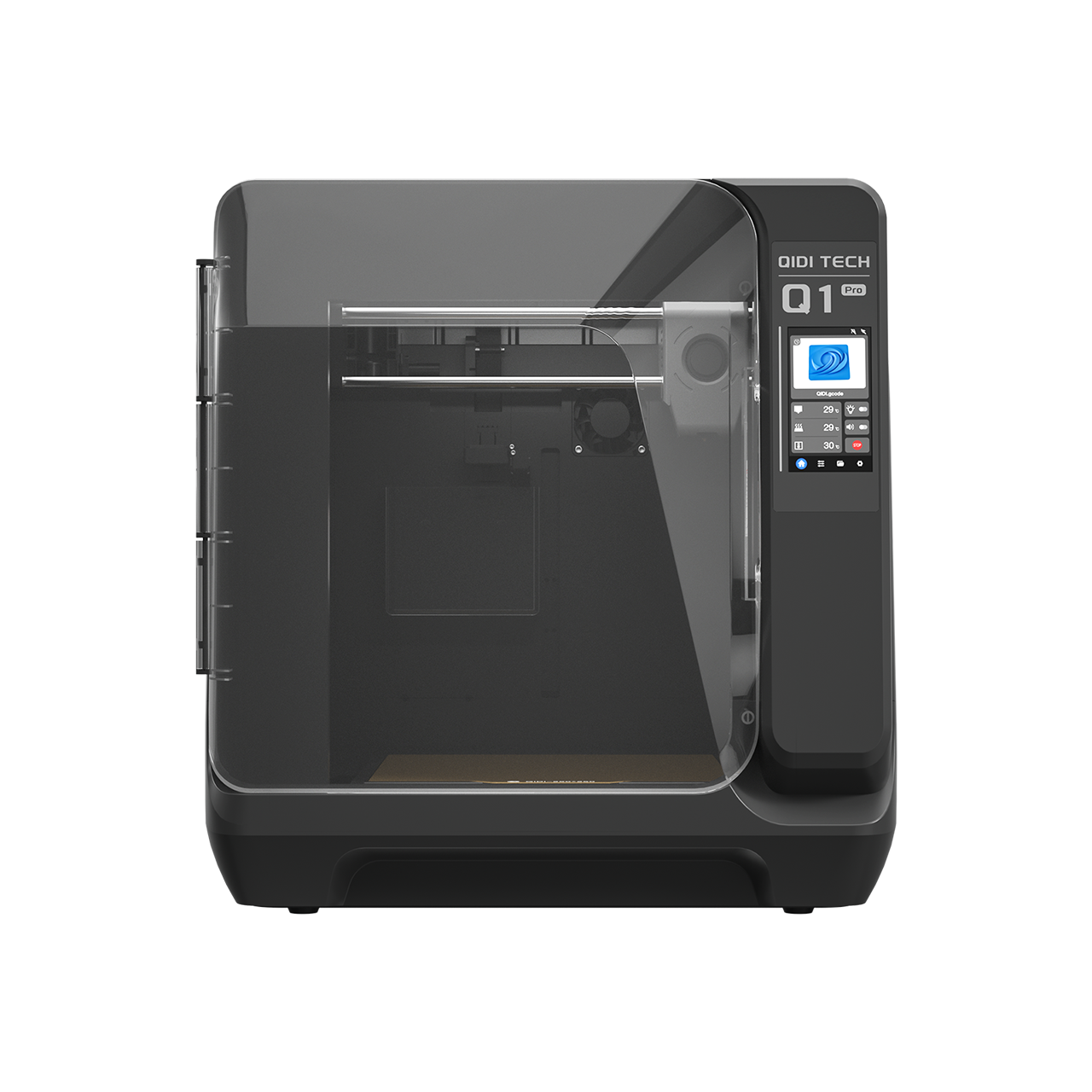
Machines with active chamber heating in the current line-up: the QIDI Q2 and QIDI Plus 5 (65 °C) and the QIDI Max4 (65 °C, 390 × 390 × 340 mm). The entry-level Q2C has a flame-retardant enclosure but no chamber heater — its spec sheet reads "Chamber Temperature: No" — so treat it as a PETG-and-PLA machine unless you add your own ambient control.

Weathering: the case where ASA wins outright
A 2023 study tested PLA, PETG, ABS and ASA from three manufacturers each through five separate degradation regimes: 20 h and 100 h under a 125 W mercury UV lamp, 100 h in a condensation chamber at 100 % humidity and 55 °C, 130 freeze-thaw cycles from −18 °C to 21 °C, 100 h in a 60 °C furnace, and 98 days of real outdoor exposure. ASA came out as the material whose properties were "least affected by individual factors", with no significant influence on ultimate strength across most exposures. PLA in the condensation chamber lost up to 28 % of its tensile strength.
That is the deciding argument for outdoor HVAC brackets, condenser-unit mounts and anything on an exterior wall. Pure PC yellows and embrittles in sunlight; ASA does not. Our ABS vs ASA comparison for outdoor structural mounts and ASA vs PETG in direct sunlight go further into the weathering mechanism.
Flame retardancy near electrical components
For a mount that sits near a junction box, a heating element or a motor, flammability rating matters more than either HDT or stiffness. QIDI's PC/ABS-FR uses a non-halogen flame retardant and the product page states it reaches UL94 V-0 at 2 mm — meaning a 2 mm specimen self-extinguishes within the V-0 test's time limits. Thinner walls are not covered by that rating, so if you are relying on it, design the wall at 2 mm or above in the flame-exposed region.
This is a material property in a lab test, not a fire-safety guarantee for your installation. Printed parts near heat sources or wiring still carry real risk, and local electrical and fire codes govern what is permitted. Treat V-0 as one factor among several, not as permission.
Application scenarios
| Location | Dominant stressor | Pick | Why |
|---|---|---|---|
| Dishwasher vent or rack area | Steam, detergent, ~70 °C | ASA or PETG-CF | Chemical and moisture resistance beat raw HDT here; see our dishwasher rack clip guide |
| Oven-adjacent wall mount holding weight | Dry heat plus sustained load | PC/ABS-FR | 102 °C HDT and 19.90 kJ/m² impact; creep resistance under constant load |
| Exterior HVAC / condenser bracket | UV, rain, freeze-thaw | ASA-CF20 Core | Weathering stability, 4503 MPa modulus resists wind flutter |
| Laundry / dryer duct clip | Warm, damp, low load | PETG-CF | 77 °C HDT is enough, no chamber heating needed |
| Near wiring or a heating element | Ignition risk | PC/ABS-FR at ≥2 mm wall | UL94 V-0 rating applies at that thickness |
Annealing: worth it, with a cost
Post-print annealing relieves internal stress and lets polymer chains reorganize, which raises effective heat resistance. The trade is dimensional: parts contract along the print direction and expand across it as stress releases. If your mount has bolt holes on a fixed pitch, anneal a test coupon first and measure the pitch before and after. For a bracket with 100 mm hole spacing, even 0.5 % shrinkage moves a hole half a millimetre — enough to bind on an M4 screw.
Practical sequence: anneal the part with a support fixture (a printed cradle in a higher-temperature material, or a bed of sand) so it cannot sag under its own weight while soft, ramp slowly, and cool slowly inside the oven rather than pulling it out into room air.
Frequently asked questions
Is ASA or PC better for a mount that gets hot?
On published numbers they are nearly tied: QIDI's ASA-CF20 Core is 101.1 °C HDT at 0.45 MPa, PC/ABS-FR is 102 °C. Pick PC/ABS-FR if the part takes impacts or sustained load, or if flame retardancy matters. Pick ASA if the part sees sunlight, rain or steam.
What temperature can a 3D printed appliance bracket actually survive?
Design to your measured surface temperature plus 20 °C of margin against the material's low-load HDT. For PC/ABS-FR at 102 °C HDT, that means a measured T-max of roughly 80 °C. Above that, no common FDM filament is a responsible choice for a permanent mount.
Do I need a heated chamber for ASA?
For small clips, an enclosure alone often suffices. For anything with a footprint over roughly 100 mm, active chamber heating is what prevents corner lift — and the measured thermal gradient data above explains why: at 30 °C ambient the gradient through the part is twice what it is at 90 °C.
Can I use PETG instead and save the trouble?
Below about 55 °C measured surface temperature, yes — PETG Basic's 71.8 °C HDT gives adequate margin and it prints without a chamber. Above that you are relying on margin you do not have. Our PETG load-bearing bracket guide covers where the line sits.
Why did my PC print come out weak even though it looked fine?
Almost certainly moisture. At 0.15 % absorbed water, printed PC hits 11.7 % porosity and loses around 30 % of its longitudinal strength and up to 70 % transversely. Dry the spool at 70–80 °C for 4–6 hours and keep it under 15 % RH while printing.
Which QIDI printers can run these materials?
PC/ABS-FR and the composite ASA grades need an enclosure with active chamber heating — the Q2, Plus 5 and Max4 all provide 65 °C. Browse the current line-up in the 3D printer collection and the material options under high-performance filaments and ASA-Aero / PC-ABS-FR.
Disclaimer: This article is for informational purposes only. 3D printed parts installed near high-heat appliances or electrical components carry real risk of deformation, failure or fire. Published material data comes from standardized test specimens and does not predict the behaviour of your specific part under your specific load. Always follow the appliance manufacturer's safety guidance and comply with local fire and electrical codes.
- The two numbers that actually decide this
- Published values for the materials QIDI sells
- Measure your mount location before you pick a material
- The failure mode nobody designs for: creep
- Moisture destroys PC before heat ever gets the chance
- Chamber temperature: what it actually changes
- Weathering: the case where ASA wins outright
- Flame retardancy near electrical components
- Application scenarios
- Annealing: worth it, with a cost
- Frequently asked questions
- Is ASA or PC better for a mount that gets hot?
- What temperature can a 3D printed appliance bracket actually survive?
- Do I need a heated chamber for ASA?
- Can I use PETG instead and save the trouble?
- Why did my PC print come out weak even though it looked fine?
- Which QIDI printers can run these materials?
Prodotti consigliati