
 Q2
Q2




Why Chamber Heating Prevents Cracks in Nylon Kitchen Aids


Active chamber heating prevents cracking in nylon prints by shrinking the temperature gradient between the part being deposited and the air around it, which is what locks residual stress into the part in the first place. A 60–65 °C chamber keeps each freshly deposited layer near or above the polymer's glass transition temperature for longer, so the layers below can relax instead of setting under tension.
What is actually cracking, and why it happens later
Nylon parts that crack weeks after printing are failing at the layer interfaces, not through the bulk material. The crack follows the horizontal plane between deposited layers because that is where the polymer chains had the least opportunity to interdiffuse across the weld.
Residual stress is internal tension left in a part after processing, caused by different regions of the part cooling and contracting at different rates. In an unheated enclosure, the outer skin of a nylon print drops through its solidification range within seconds while the core is still hot and contracting. The skin sets first and then resists the core's continued shrinkage. That tug-of-war is stored in the part as elastic strain, and it does not go away when the print finishes.
Nylon (polyamide) is a semi-crystalline thermoplastic, which means it has both ordered crystalline domains and disordered amorphous ones. That structure gives nylon its toughness and chemical resistance, and it is also why cooling rate matters so much: crystallisation is time-dependent, so how fast the part cools changes the structure that forms, not just the stress that is trapped.
The delayed failure pattern makes sense once you see it as stored energy. A dishwasher cycle at around 70 °C, or a hot car, supplies enough thermal energy for those strains to relieve themselves — by opening the weakest available interface. Our nylon 3D printing guide covers the material's broader handling requirements; this page is about the chamber specifically.
How chamber heating changes the outcome
The mechanism is time above glass transition temperature at the interlayer weld. Polymer chains diffuse across a layer boundary only while they retain mobility, and mobility effectively stops once the interface cools to the glass transition temperature.
Research on interlayer bond strength in nylon copolymers during fused filament fabrication models exactly this, treating chain mobility as ceasing when the interface temperature reaches the copolymer's glass transition — measured at 49 °C for the high-molecular-weight polyamide and 41 °C for the low-molecular-weight one in that study. Raise the ambient temperature and the interface spends longer above that threshold on every layer.
That study also produced a result worth reporting honestly, because it complicates the simple story. Raising the build plate temperature from 40 °C to 110 °C produced similar or slightly weaker interlayer bonds despite the longer weld time, because the elevated temperature increased crystallinity by roughly 1.5 times and reduced tie-chain density in the amorphous regions between lamellae. More heat is not automatically more bond strength in a semi-crystalline polymer. Liquefier temperature had the larger effect in their data — a 40 °C increase raised tear energy by a factor of three to four.
So the accurate claim for chamber heating is narrower than "it makes layers stick better." Its documented contributions are:
- Reducing the thermal gradient across the whole part, which is the direct cause of residual stress and warping.
- Extending time above Tg at the interface, which supports chain interdiffusion.
- Removing draughts and ambient swings, which cause uneven shrinkage between one side of a part and the other.
Work on optimising interlayer bonding in additively manufactured polymers makes the same point about keeping the interlayer contact zone above the glass transition temperature, and demonstrates roughly a 15% increase in ultimate interlayer tensile strength on short carbon-fibre-reinforced polyamide when the deposition surface is actively preheated. Those are real but moderate gains — meaningful for a functional part, not transformative.
Moisture is the other half of the problem
Nylon is strongly hygroscopic, and absorbed water acts as a plasticiser that lowers the glass transition temperature and the modulus below it. That is not a printing artefact; it is a documented property of the polymer family, along with the dimensional change that accompanies moisture uptake.
Two consequences follow. During printing, water in the melt causes bubbling, poor surface finish and voids at layer boundaries — defects that become crack initiation sites. In service, a part that absorbs moisture swells; if the layer bonds are already carrying residual stress, that swelling acts as a wedge along the interface.
This is why drying is not optional and why a heated chamber and a dry spool are complementary rather than alternative fixes. A perfectly dried nylon printed cold will still crack. A wet nylon printed in a 65 °C chamber will still bubble. Our filament drying guide covers the equipment side.
Parameters for nylon and nylon composites
Chamber temperature should sit at or just above the material's glass transition temperature, and drying should happen immediately before printing rather than the night before. The table below gives working starting points; always defer to the filament manufacturer's technical data sheet, since additive packages shift these numbers.
| Material | Nozzle | Bed | Chamber | Drying | Moisture sensitivity |
|---|---|---|---|---|---|
| PA6 / PA66 | 250–280 °C | 70–90 °C | 50–60 °C | 70–80 °C, 8–12 h | Very high — hours of exposure matter |
| PA12 | 250–270 °C | 70–90 °C | 50–60 °C | 70 °C, 6–8 h | Moderate — lower uptake than PA6 |
| PA12-CF (carbon filled) | 270–300 °C | 80–100 °C | 60–65 °C | 80 °C, 8–12 h | Moderate; abrasive, needs a hardened nozzle |
| PPA (UltraPA) | 290–320 °C | 90–110 °C | 60–65 °C | 80–90 °C, 10–12 h | Lower than PA6, still requires drying |
| PPA-GF (PAHT-GF) | 290–320 °C | 90–110 °C | 65 °C | 80–90 °C, 10–12 h | Lower; glass fill is abrasive |
Cooling fan settings matter as much as chamber temperature and pull in the opposite direction. Run part cooling at 0–20% for nylon. Aggressive cooling is the fastest way to reintroduce exactly the thermal gradient the chamber exists to remove.
For the carbon-filled grades, the fibre does independent work: it lowers the coefficient of thermal expansion and distributes stress through the matrix, which is why PA12-CF warps less than unfilled PA12 at the same chamber temperature. Our carbon fibre filament guide covers nozzle wear and handling. Unfilled and high-temperature options include UltraPA (PPA) and PAHT-GF.
Chamber temperature against failure mode
Matching chamber capability to part geometry is more useful than a single recommended number. Small parts tolerate cold chambers because their thermal gradients are small; tall or large-footprint parts do not.
| Chamber condition | Small part, under 50 mm tall | Tall or large part | Typical failure mode |
|---|---|---|---|
| Open frame, room temperature, draughty | Marginal | Fails | Corner lift during printing, then delamination in service |
| Passive enclosure, 30–40 °C from waste heat | Usually fine | Unreliable | Warping on long thin features; inconsistent between prints |
| Active chamber, 50–60 °C | Reliable | Reliable for most geometries | Residual risk at very large footprints |
| Active chamber, 65 °C | Reliable | Reliable | Filament dryness and part design become the limiting factors |
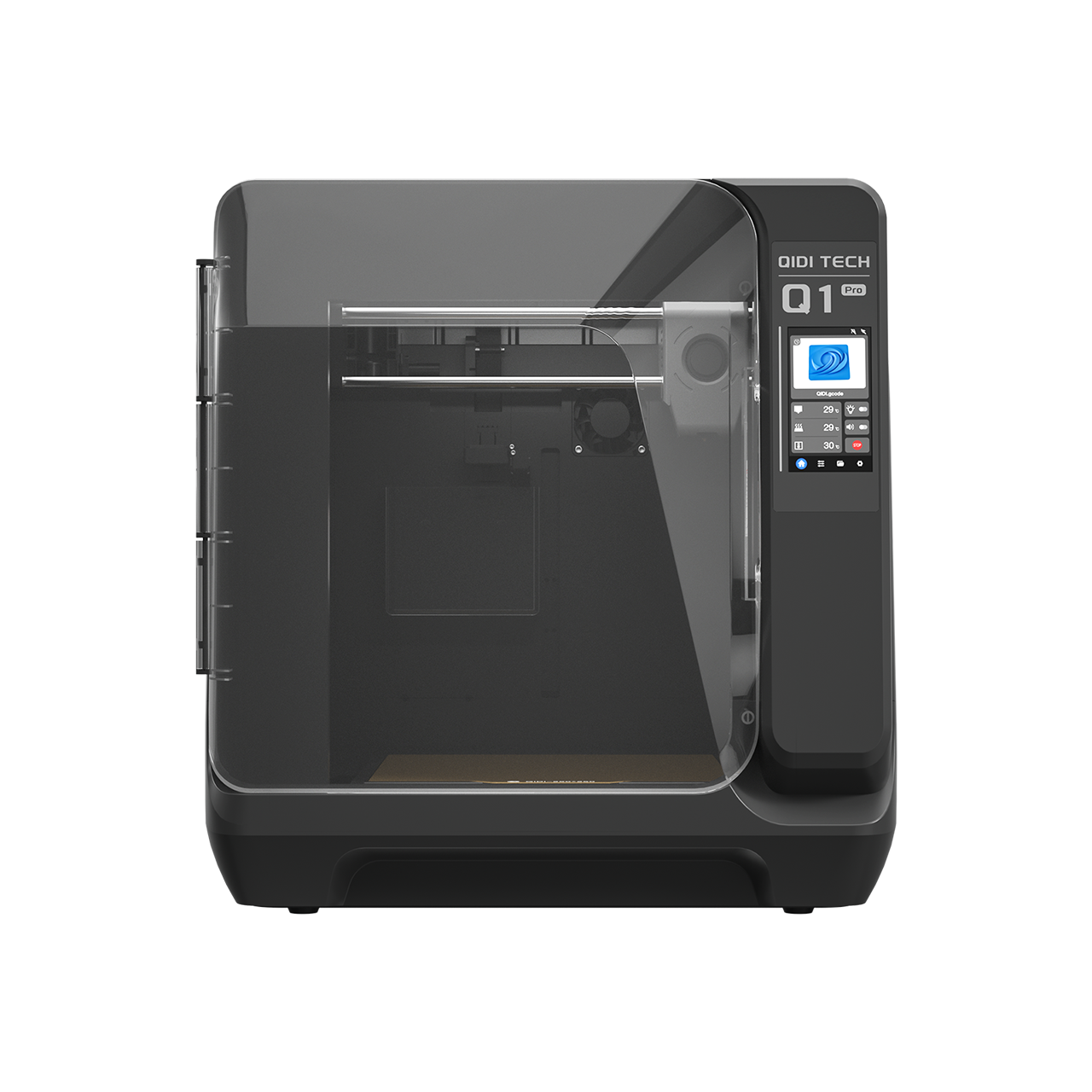
On the hardware side, the Q2, Plus 4 and Max4 all provide independent active chamber heating to 65 °C alongside 370 °C hotends, which is the combination nylon and its composites need. The Q2C is worth calling out for the opposite reason: it uses a flame-retardant closed chamber with no active chamber heating, so it sits in the passive-enclosure row of the table above. It handles PLA, PETG and TPU well; large nylon parts are not what it is built for. Our explainer on the temperature-controlled chamber covers the distinction between passive and active enclosures in more detail.
A workflow that survives the dishwasher
- Dry the filament immediately before printing at the temperature and duration in the table, and keep it in a heated dry box during the job. A spool dried yesterday and left on the shelf is a wet spool.
- Set the chamber and let it soak. Allow 15–20 minutes at temperature before starting so the build plate, frame and air reach equilibrium. Starting a print into a chamber that is still climbing produces a part whose first 20 layers printed in different conditions from the rest.
- Use a hardened nozzle for any filled grade and hold nozzle temperature at the upper end of the recommended range. Liquefier temperature had the strongest measured effect on bond strength in the nylon copolymer study.
- Fan at 0–20%, walls at 4 or more, infill at 40%+ gyroid or cubic for functional parts. Gyroid distributes load in multiple directions, which suits parts that see thermal cycling rather than a single load axis.
- Cool inside the closed chamber. Let the machine come down to room temperature with the door shut. Pulling a hot nylon part into a 20 °C room reintroduces a thermal shock at the last possible moment.
- Anneal if the part is genuinely load-bearing. A soak below the melting point relieves remaining stress and increases crystallinity. Expect some dimensional change and design in the allowance rather than annealing a part that must fit precisely.
Common mistakes
- Running part cooling at PLA settings. This single setting undoes most of what the chamber achieves.
- Treating a passive enclosure as an active chamber. Waste heat from the bed typically reaches 30–40 °C, below the glass transition of most polyamides. It reduces draughts; it does not control the gradient.
- Using PLA or PETG for dishwasher-exposed parts. PETG's glass transition sits near 80 °C, which overlaps dishwasher drying cycles — see our guide to printing dishwasher rack clips in PETG for where it does and does not hold up.
- Thin walls with high infill. For thermally cycled parts, wall count does more than infill density. Two walls at 60% infill is weaker at the surface than four walls at 40%.
- Assuming a nylon part is food safe because it is durable. It is not the same question. Heat resistance and food-contact compliance are independent, and printed geometry sits outside food-contact clearances regardless of resin — our guide on whether PETG is food safe works through why.
General terminology is covered by Purdue University Libraries' 3D printing glossary and the UT Health San Antonio filament and materials guide.
Frequently asked questions
What chamber temperature do you need for nylon?
50–60 °C for unfilled PA6, PA66 and PA12; 60–65 °C for carbon- and glass-filled grades and for PPA. The target is at or slightly above the polymer's glass transition temperature, which for common polyamide copolymers has been measured in the 41–49 °C range. Higher is not automatically better — chamber air much above 70 °C starts to soften parts and stress printer electronics.
Why do my nylon prints crack after they come off the printer?
Almost always residual stress from an uncontrolled thermal gradient, occasionally moisture in the filament, and usually both. The crack appears at a layer interface because that is the weakest plane. If the part cracked days or weeks later, something supplied thermal energy — a dishwasher, a warm car, a sunny window — that let stored strain relieve itself.
Can I print nylon without a heated chamber?
Small parts under about 50 mm tall, in PA12 rather than PA6, in a draught-free passive enclosure, printed slowly with cooling off — yes, with acceptable results. Tall parts, wide flat parts, and anything that will be loaded or thermally cycled will be unreliable. Passive enclosures typically reach only 30–40 °C, below the glass transition of the polymer.
Does chamber heating replace annealing?
No. Chamber heating prevents stress from being locked in during printing; annealing relieves what is already there and increases crystallinity afterwards. Doing both gives the most dimensionally stable part. Annealing alone on a badly stressed print often causes visible warping as the stress releases.
Is carbon fibre nylon less likely to crack than plain nylon?
Generally yes, because the fibre lowers the coefficient of thermal expansion so there is less shrinkage to fight, and it distributes stress through the matrix. The trade-offs are real: filled filaments are abrasive and need a hardened nozzle, they are more notch-sensitive, and they still need both drying and a heated chamber.
How long should nylon dry before printing?
6–12 hours depending on grade and how long the spool has been exposed, at 70–90 °C. Then keep it in a heated dry box for the duration of the print. Polyamides reabsorb moisture from room air within hours, which is why drying the night before and printing the next afternoon does not work.
- What is actually cracking, and why it happens later
- How chamber heating changes the outcome
- Moisture is the other half of the problem
- Parameters for nylon and nylon composites
- Chamber temperature against failure mode
- A workflow that survives the dishwasher
- Common mistakes
- Frequently asked questions
- What chamber temperature do you need for nylon?
- Why do my nylon prints crack after they come off the printer?
- Can I print nylon without a heated chamber?
- Does chamber heating replace annealing?
- Is carbon fibre nylon less likely to crack than plain nylon?
- How long should nylon dry before printing?
Empfohlene Produkte