
 Q2
Q2




Is PETG Food Safe? The Truth About Cookie Cutters


PETG resin is authorised for food contact, but a 3D-printed PETG object is not automatically food safe. The approvals in 21 CFR 177.1630 and EU Regulation 10/2011 cover the base polymer under stated conditions of use — not colourants, not nozzle wear particles, and not the porous layer structure FDM creates. For cookie cutters specifically, the brief, cool, dry contact makes the real-world risk low.
What the regulations actually cover
Food-contact regulations approve substances under defined conditions of use; they do not certify finished consumer objects. That distinction is the whole answer to this question, so it is worth being precise about it.
PETG (polyethylene terephthalate glycol-modified) is a copolyester in which part of the ethylene glycol in ordinary PET is replaced by CHDM (cyclohexanedimethanol). The substitution suppresses crystallisation, which is why PETG stays clear and prints without the sharp crystallisation shrinkage of PET.
United States: 21 CFR
Polyethylene phthalate polymers, including glycol-modified grades, are listed under 21 CFR 177.1630, which sets identity requirements and extractives limits for the resin. Three further sections matter and are routinely left out of "PETG is FDA approved" claims:
- 21 CFR 174.5 — general provisions requiring any food-contact substance to be of a purity suitable for its intended use and used at no more than the quantity needed to achieve its effect.
- 21 CFR 178.3297 — colorants for polymers, permitted only where the colorant does not migrate to food. Filament pigment and masterbatch sit here, and filament makers rarely publish this data.
- 21 CFR 175.300 — resinous and polymeric coatings, the section a food-safe epoxy sealant is certified under.
The FDA's summary of how food-contact substances are regulated makes the framing explicit: clearance attaches to a substance in a described application, not to an object.
European Union
Under EU Regulation 10/2011, PET's constituent monomers appear in Annex I with specific migration limits — terephthalic acid at 7.5 mg/kg food and ethylene glycol at 30 mg/kg food — under an overall migration limit of 10 mg/dm² for all plastic substances combined. Again, these are limits on a material tested under specified simulant conditions.
The gap between approved resin and printed part
A printed PETG part differs from injection-moulded food packaging in four ways that fall outside the approvals:
- FDM layer lines create microscopic grooves that harbour bacteria and resist cleaning.
- The brass nozzle the melt passes through commonly contains lead as a machining aid.
- Colourants, UV stabilisers and flow modifiers added during filament manufacture may carry no food-contact clearance of their own.
- Internal voids between perimeters and infill can trap moisture and organic residue that never dries out.
None of that makes printed PETG dangerous. It makes "PETG is FDA food safe" an incomplete sentence. The answer depends on what you print, how you print it, and how the part meets food. The same reasoning drives our guide to choosing between filament types.

Why layer lines are the real hygiene problem
Surface roughness, not polymer chemistry, is the dominant food-safety variable in FDM printing. FDM deposits material with a roughly circular cross-section, so every layer leaves a V-shaped valley against the one below it. At a 0.2 mm layer height those valleys are on the order of 200 µm deep. A Salmonella cell is about 0.5 µm wide and 2–5 µm long, which makes the grooves roughly two orders of magnitude larger than the organisms that can settle in them.
A 2021 study in Frontiers in Microbiology found biofilms accumulated preferentially between layers, with bacteria filling the grooves and bridging between the highest parallel layers. After two hours of exposure, E. coli attachment ranged from 6.5 × 10⁶ to 1.9 × 10⁷ cells depending on material.
Surface roughness by layer height
| Layer height | Typical surface roughness (Ra) | Cleaning difficulty |
|---|---|---|
| 0.1 mm | 3–6 µm | Lower — shallower grooves, brush reaches the bottom |
| 0.2 mm | 9–15 µm | Moderate — standard setting, layer lines clearly visible |
| 0.3 mm | 20–38 µm | Higher — deep grooves, substantially more surface area |
| Injection moulded (reference) | Under 1 µm | Trivial — this is the benchmark printed parts do not meet |
Cleaning does work; it just takes more effort than washing a smooth moulded utensil. A Utah Valley University microbiology and engineering project — published by the researchers as a public writeup rather than in a peer-reviewed journal, which is worth weighing when you read the figures — reported that dish soap and warm water at roughly 49 °C removed 90% or more of the pathogens tested, with a baking-soda scrub or dilute bleach rinse clearing the remainder. Treat that as encouraging rather than as a validated cleaning protocol.
Nozzle brass, lead, and how much it matters
Standard brass nozzles are machined from a leaded alloy, and the honest position is that transfer is very likely small but has not been well quantified. C36000 free-cutting brass contains roughly 2.5–3.7% lead by weight, added to make the alloy machinable. A typical 0.4 mm nozzle weighing about 3 g therefore contains on the order of 0.075–0.11 g of lead in the body, of which only the fraction lining the melt channel could ever contact filament.
The UVU project weighed new nozzles against nozzles with over 1,000 hours of use and found no measurable mass loss. That is a genuine data point, with a genuine limitation: gravimetric weighing is a blunt instrument for detecting microgram-scale transfer, so "no measurable loss" means below their detection threshold, not zero.
If lead is a concern for you, the fix is cheap and removes the variable entirely: print food-contact parts with a 304 or 316 stainless steel nozzle. The trade-off is thermal — stainless conducts at roughly 15 W/mK against brass at about 115 W/mK — so expect to raise nozzle temperature 5–10 °C or slow down slightly to keep flow stable.
Why cookie cutters are a low-risk case
Cookie cutters sit at the favourable end of every migration variable that matters. Migration of any substance from plastic into food scales with contact time, temperature, fat content and liquid contact. A cutter fails to be demanding on all four counts.
| Risk factor | Cookie cutter | Drinking cup (for contrast) |
|---|---|---|
| Contact duration | 2–5 seconds per press | 10–60 minutes per use |
| Contact temperature | 20–25 °C raw dough | Up to 90 °C for hot drinks |
| Liquid contact | None — dough is a solid | Continuous immersion |
| Fat and acid exposure | Brief, low | Sustained; coffee and juice are aggressive simulants |
| Post-contact kill step | Yes — baked at 175–200 °C for 10–15 minutes | None |
| Reasonable verdict | Low risk with routine washing and periodic replacement | Not advisable uncoated, whatever the filament |
The baking step deserves emphasis. Salmonella is inactivated at about 74 °C and E. coli at about 70 °C, and a cookie bakes far above both. Prusa's own food-safe FDM printing guidance reaches a similar conclusion for cutters, with the same caveat that layer lines collect residue and cutters should be treated as semi-disposable.
How to make printed PETG safer for food contact
Reducing porosity and eliminating unknown additives are the two interventions that actually change the risk profile. Print settings do the first; material choice does the second.
| Setting | Recommended value | Why it matters |
|---|---|---|
| Layer height | 0.1–0.15 mm | Cuts surface roughness from ~20 µm Ra to ~3–6 µm Ra |
| Wall count | 4–5 minimum | Removes internal porosity at the food-contact face |
| Infill | 100%, or 50%+ behind thick walls | Eliminates voids that trap moisture and residue |
| Nozzle temperature | +5–10 °C above your normal PETG profile | Improves interlayer fusion, shrinking micro-gaps |
| Extrusion multiplier | 105–110% | Forces material into gaps; costs dimensional accuracy |
| Nozzle material | Stainless steel (304/316) | Removes the leaded-brass variable |
| Filament colour | Natural / uncoloured | Avoids pigments with unknown 178.3297 status |
PETG Basic and the faster-flowing PETG Rapido both suit this kind of work; the Rapido's higher flow rate helps interlayer bonding at elevated temperatures. The full PETG filament range lists the available grades. Whichever spool you choose, request the manufacturer's technical data sheet and check whether it makes any food-contact statement at all — most consumer filament does not, and the absence of a claim is itself informative.
Coatings
A food-safe epoxy coating seals the pores that create the hygiene problem, which is why the coating matters more than the base filament for sustained-contact items. A coated PLA part can be safer than an uncoated PETG one. Choose a product certified under 21 CFR 175.300, follow the mix ratio and full cure time exactly, and understand the limitation: coatings abrade with washing and use, so inspect regularly and re-coat or retire the part when wear shows. A partially worn coating is worse than none, because it hides the porosity it no longer seals.
Sealing a print well is a design problem as much as a material one — our guide to designing watertight end caps works through the wall thickness and overlap that make a printed part genuinely leak-free.
When to worry and when not to
Separate the variables and the decision becomes straightforward. Match the precautions to the actual contact scenario rather than applying one blanket rule to every kitchen print.
| If the part… | Then… |
|---|---|
| Touches solid food briefly at room temperature (cutters, dough stamps, one-use chocolate moulds) | Uncoated PETG at 0.1–0.15 mm with a stainless nozzle is reasonable. Wash after use, replace when worn or discoloured |
| Holds liquid or hot food (cups, bowls, straws, utensils) | Coat it, inspect it, and seriously consider a commercial moulded product instead |
| Goes into a dishwasher | Reconsider. PETG's Tg of 80–85 °C overlaps dishwasher drying cycles at 65–80 °C. Hand wash |
| Contacts raw meat, or is used by someone immunocompromised | Do not use a printed part. Porosity plus a vulnerable user is the one combination not worth optimising |
| Never touches food (spice racks, drawer dividers, pan lid holders) | Material safety is a non-issue. Print in whatever performs best |
For items near heat but not in it, the trade-offs in our PLA and water exposure guide apply, and outdoors the failure mode shifts from hygiene to UV — covered in ASA vs PETG in direct sunlight. The PLA toxicity guide approaches the same regulatory question from the PLA side.
Frequently asked questions
Is PETG food safe for 3D printing?
PETG resin is authorised for food contact under 21 CFR 177.1630 and EU 10/2011, but that clearance covers the polymer under defined conditions, not a finished printed object. A printed part adds layer-line porosity, possible nozzle metal transfer and uncleared colourants. For brief room-temperature contact with solid food, the practical risk is low. For sustained or hot contact, seal the part or buy a moulded one.
Is PETG safer than PLA for cookie cutters?
Marginally, and mostly for heat reasons. Both are listed food-contact polymers in raw form. PETG's glass transition temperature of 80–85 °C beats PLA's 55–60 °C, so PETG tolerates warm washing without deforming. Neither is fully food safe uncoated, because the porosity issue is identical.
Can I put 3D-printed cookie cutters in the dishwasher?
Hand wash instead. PETG softens near 80–85 °C and dishwasher drying cycles reach 65–80 °C, close enough that repeated cycles risk warping thin cutter walls. Warm water and dish soap remove the great majority of surface organisms in the testing that exists.
Do I need a food-safe coating on a cookie cutter?
Not for occasional use with a wash-and-dry routine, if it is printed at 0.1–0.15 mm with a stainless nozzle. For anything with sustained food contact — bowls, cups, utensils — a coating certified under 21 CFR 175.300 is what actually seals the layer structure, and it needs regular inspection.
What about PLA cookie cutters?
They work. Brief contact with room-temperature dough is a low-demand application. Two caveats: PLA softens in hot water, so wash lukewarm; and PLA degrades faster in damp conditions. Retire them once the surface looks or feels changed.
How can I tell whether a filament is genuinely food-contact grade?
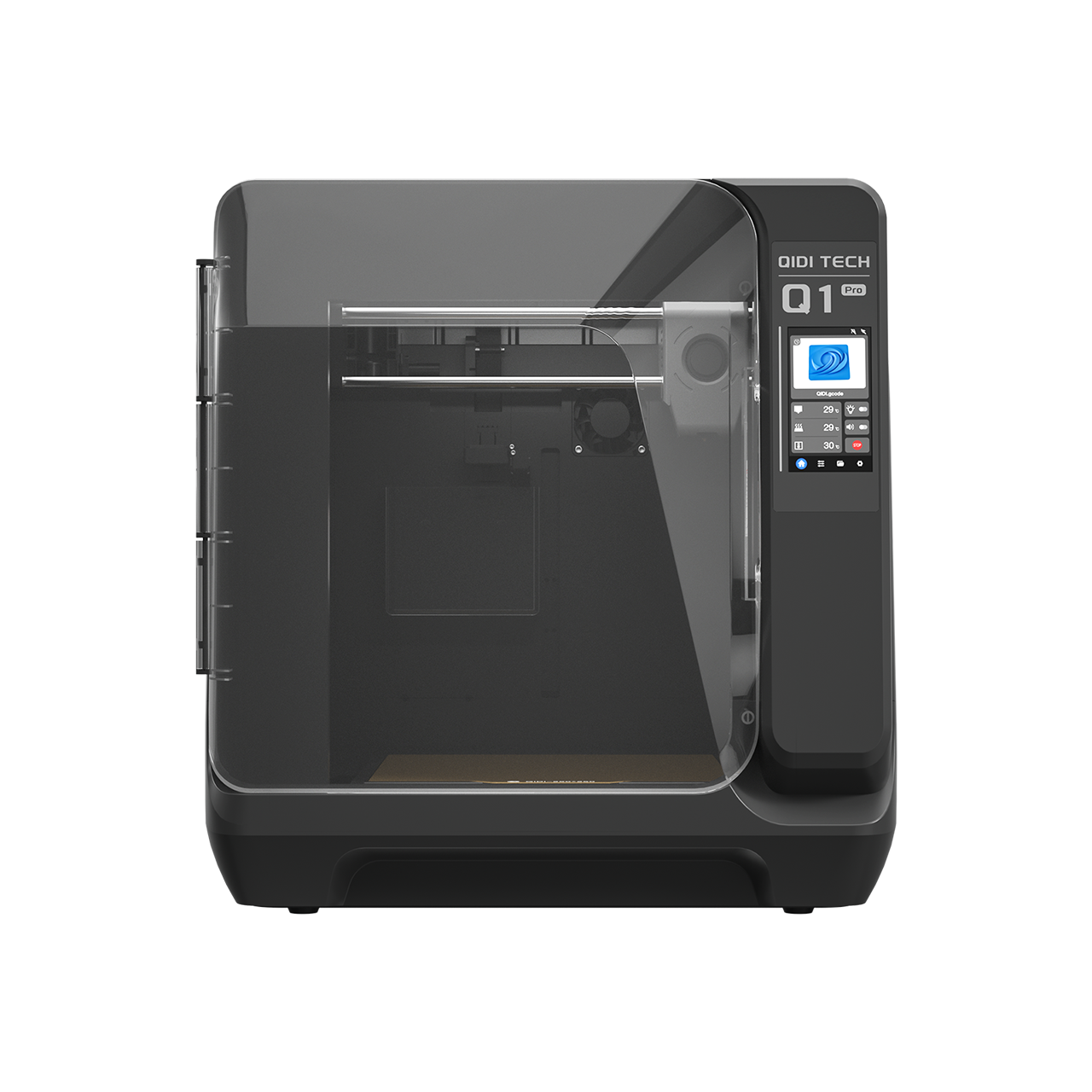
Ask the manufacturer for the technical data sheet and look for a specific regulatory citation — a CFR section number or an EU 10/2011 declaration of compliance — rather than the phrase "food safe" on a marketing page. Then remember the claim applies to the resin as supplied, not to your printed part. Our beginner filament guide covers how to read a TDS, and the espresso accessories guide shows where the same reasoning lands for kitchen tools. Printers with well-calibrated PETG profiles, such as the QIDI Q2, help hold the tight tolerances that cutters need, but no printer changes the regulatory picture.
- What the regulations actually cover
- United States: 21 CFR
- European Union
- The gap between approved resin and printed part
- Why layer lines are the real hygiene problem
- Surface roughness by layer height
- Nozzle brass, lead, and how much it matters
- Why cookie cutters are a low-risk case
- How to make printed PETG safer for food contact
- Coatings
- When to worry and when not to
- Frequently asked questions
- Is PETG food safe for 3D printing?
- Is PETG safer than PLA for cookie cutters?
- Can I put 3D-printed cookie cutters in the dishwasher?
- Do I need a food-safe coating on a cookie cutter?
- What about PLA cookie cutters?
- How can I tell whether a filament is genuinely food-contact grade?
Рекомендуемые продукты