
 Q2
Q2




Best Filament for Snap-Fit Clips: Nylon vs TPU Toughness


The Engineering Challenge of Snap-Fit Design
In functional 3D printing, the snap-fit clip represents a complex intersection of material science and geometric design. Whether you are replacing a broken dishwasher rack clip or developing a custom enclosure for a small-scale production run, the choice between Nylon and TPU (Thermoplastic Polyurethane) is rarely straightforward. It is a balancing act between structural rigidity and the ability to survive repeated deformation without failure.
For serious makers and prosumers, moving beyond aesthetic models to functional parts requires a shift in mindset. We no longer ask "will it print?" but rather "how many cycles will it survive?"
Understanding the Physics of Snap-Fits
A snap-fit works by briefly deforming a cantilever beam to clear a retention lip, then allowing it to "snap" back into its original position. This process subjects the material to two primary stresses: tensile stress on the outer curve and compressive stress on the inner curve.
Fatigue is the progressive structural damage that occurs when a material is subjected to cyclic loading. Snap-fit clips often fail after repeated use rather than on the first cycle, especially when micro-cracks develop at stress concentration points.
Nylon: The Industrial Standard for Precision Retention
Nylon (Polyamide) is often the first choice for engineering-grade clips because it offers a high "stiffness-to-flexibility" ratio. It provides a satisfying, audible "click" and maintains a high retention force, ensuring that once the clip is engaged, it stays engaged.
Nylon's Long-Cycle Reliability
In practice, Nylon's fatigue resistance can become more valuable as cycle counts increase, although service life depends on geometry, moisture, orientation, and print quality. While softer materials might stretch over time, a well-designed Nylon clip retains its geometry. This reliability is why Additive Manufacturing (AM) is increasingly used in high-performance sectors.
The Moisture "Gotcha"
Experienced designers note that Nylon clips require careful moisture management. Nylon is hygroscopic, meaning it absorbs water from the air. While this can actually increase toughness (making the clip less brittle), humidity absorption can change stiffness and fatigue behavior, so performance should be validated at the expected service humidity. Proper drying before printing is non-negotiable for consistent mechanical properties.
TPU: The Impact-Resistant Alternative
TPU is a different beast entirely. As an elastomer, it can undergo massive deformation—often exceeding 400-600% elongation at break—and return to its original shape.
When to Choose TPU
TPU excels in applications requiring energy absorption, vibration damping, or protective bumpers — but many snap-fit clips need more retention stiffness than TPU provides. Two material properties can limit TPU in sustained clamping applications. First, its low elastic modulus means it cannot generate sufficient retention force; even 95A or 98A Shore hardness TPU will flex away from the retention lip under moderate continuous load. Second, TPU exhibits significant creep: under sustained clamping stress, the material undergoes slow, permanent deformation, causing the clip to progressively loosen over time. For impact-prone assemblies, the better solution is to use a Nylon clip paired with a TPU overmold or bumper pad — letting each material do what it does best.
A Deflection-Angle Heuristic
A useful design signal: if a snap-fit requires a large deflection angle, review the geometry and peak strain. Excessive deflection angles are the primary driver of stress concentration and fatigue failure. The correct engineering response is to increase the cantilever arm length or reduce cross-sectional thickness to lower peak strain. Switching to TPU merely trades one failure mode (fracture) for another (creep relaxation).
PEBA 95A: The High-Performance Hybrid
PEBA 95A is a genuinely impressive material for dynamic energy-return applications — running shoe midsoles, drone vibration isolators, and wearable flex joints are all legitimate use cases. However, its mechanical profile shares the same fundamental limitations as TPU when applied to snap-fit clips: insufficient elastic modulus for reliable retention force, and measurable creep under sustained load. PEBA's strengths (low hysteresis, cold-weather flexibility, light weight) are best leveraged in cyclic compression or bending applications, not in parts that must maintain a locked clamping state. Specifically, PEBA suffers from the same two disqualifying traits as TPU for clip applications: insufficient stiffness to maintain clamping force, and creep deformation under sustained load. It is not a middle-ground solution for snap-fits.
Ultimate Energy Return
Unlike standard TPU, which can feel "sluggish" in its recovery, PEBA features exceptionally low hysteresis. In plain English, it "snaps back" instantly. While traditional elastomers might offer 50-60% energy return, PEBA reaches 70%+, making it a staple in professional athletic gear and advanced damping systems.
Lightweight and Cold-Resistant
PEBA is approximately 12% lighter than standard TPU 95A, which is critical for weight-sensitive applications like drone components or wearable tech. Furthermore, while most flexibles become brittle in the cold, PEBA maintains its properties down to -40°C.
Design Best Practices for Snap-Fits
Choosing the right material is only half the battle. Your geometry must play to the material's strengths.
- Radius Transitions: Designers often underestimate the importance of radius transitions in snap-fit clips. Sharp corners in Nylon designs create stress concentrations that accelerate fatigue failure. Always use a generous fillet at the base of the cantilever.
- Print Orientation: For maximum strength, the clip should be printed so that the stress of the flex is distributed along the continuous strands of the filament, rather than pulling the layers apart.
- Wall Thickness: For Nylon, PETG, and PLA snap-fit clips, wall count has a direct impact on retention stiffness. Increasing perimeter count (rather than infill) is the most effective way to tune clip engagement force without adding unnecessary bulk.

Hardware Requirements: Taming Advanced Polymers
Printing these materials requires more than a basic setup. Nylon and high-performance elastomers are prone to warping and require precise thermal management.
The Role of the Heated Chamber
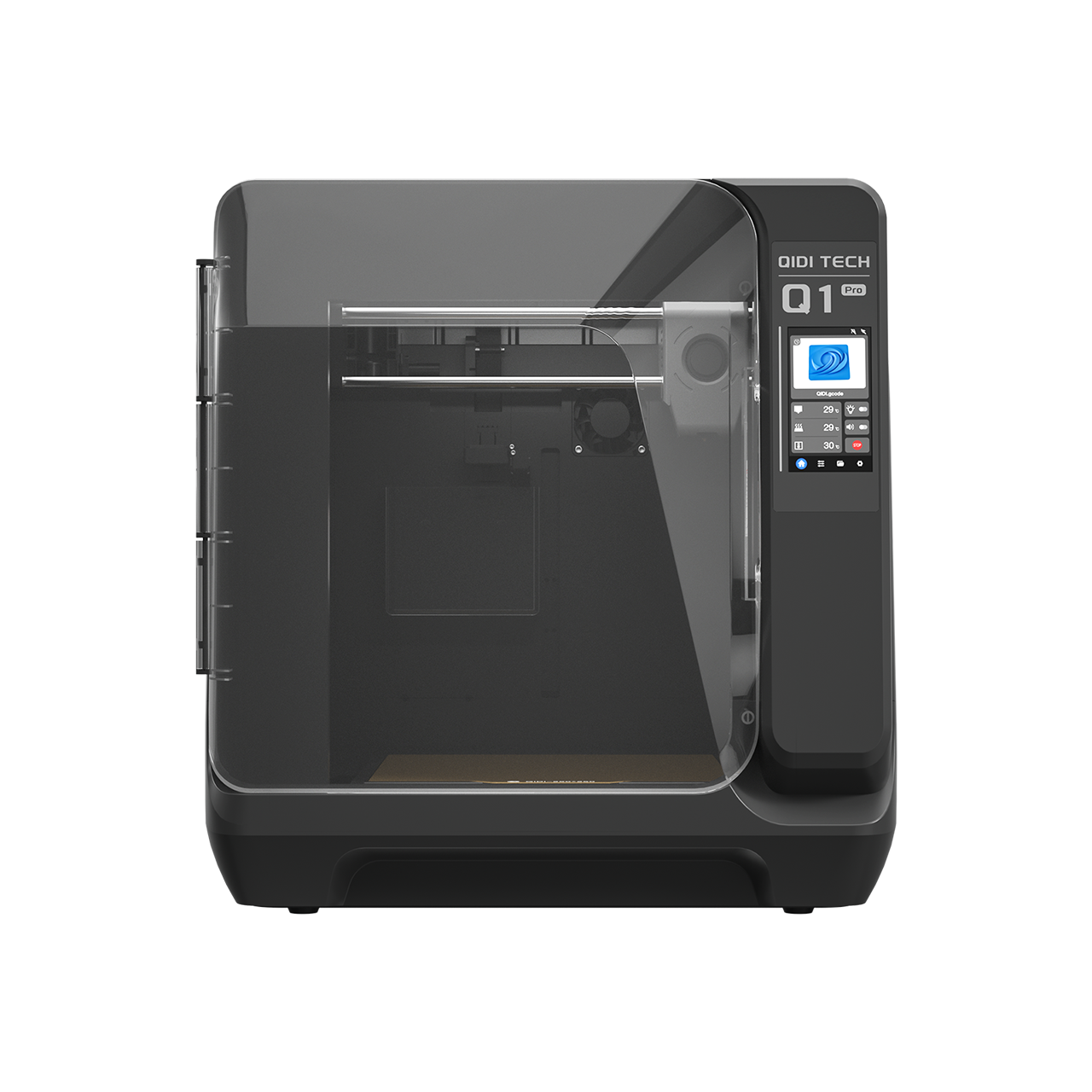
To achieve industrial-grade reliability, an active chamber heating system is highly recommended. Printers like the QIDI Max4 or the QIDI Q2 maintain a consistent internal temperature (up to 65°C), which prevents the uneven cooling that leads to warping in Nylon and PEBA.
Extrusion Precision
Because PEBA and TPU are flexible, they can "bundle up" in the extruder if there is too much space between the drive gear and the melt zone. A high-quality direct-drive extruder, found on machines like the QIDI Q2C, is essential for feeding these "noodle-like" filaments without friction or clogging.
Summary of Material Selection
Selecting the right filament for snap-fit clips depends on your specific performance requirements:
- Choose Nylon if you need high retention force, a rigid "click," and the part will operate in high-temperature environments. It is the gold standard for replacing broken dishwasher rack clips or automotive fasteners.
- Choose TPU for energy-absorbing components adjacent to your clip assembly — bumpers, vibration mounts, or protective housings — but not for the clip itself. TPU's creep behavior and lower retention force can make it unsuitable as a sustained clamping element.
- Choose PEBA 95A for dynamic flex joints, wearable hinges, or cyclic compression pads where energy return and cold-weather performance are the primary requirements. Like TPU, it is not suited for snap-fit retention applications due to creep and insufficient clamping stiffness.
For snap-fit clips specifically, the material shortlist is Nylon, PETG, and PLA — in descending order of fatigue resistance and temperature tolerance. The right answer to a difficult snap-fit geometry is better design, not a softer material.
By matching your material choice to the mechanical reality of your design, you move from "making parts" to "engineering solutions." Whether you are securing a battery cover or building a custom latch, understanding the trade-offs between Nylon and TPU ensures your 3D printed components perform reliably, cycle after cycle.
Disclaimer: This article is for informational purposes only. Mechanical performance can vary significantly based on printer settings, environmental conditions, and specific part geometry. Always perform safety testing for load-bearing or critical functional components.
- The Engineering Challenge of Snap-Fit Design
- Understanding the Physics of Snap-Fits
- Nylon: The Industrial Standard for Precision Retention
- Nylon's Long-Cycle Reliability
- The Moisture "Gotcha"
- TPU: The Impact-Resistant Alternative
- When to Choose TPU
- A Deflection-Angle Heuristic
- PEBA 95A: The High-Performance Hybrid
- Ultimate Energy Return
- Lightweight and Cold-Resistant
- Design Best Practices for Snap-Fits
- Hardware Requirements: Taming Advanced Polymers
- The Role of the Heated Chamber
- Extrusion Precision
- Summary of Material Selection
Prodotti consigliati