
 Q2
Q2




Can You 3D Print Reliable Drip Irrigation Connectors?


The Engineering Reality of 3D Printed Garden Infrastructure
For the serious gardener or small-scale farm owner, the "off-the-shelf" world of irrigation is often a series of compromises. You find yourself adapting your garden layout to the limited connector geometries available at the local hardware store, rather than building the system your plants actually need.
The question I often hear from professionals moving into prosumer workflows is: Can you actually trust a 3D printed connector to hold up under pressure without flooding the greenhouse?
The answer is a qualified "yes," but it requires moving past hobbyist "tinker" mentalities and adopting industrial design principles. In this guide, I will break down the material science, geometric requirements, and hardware necessities for creating reliable, watertight drip irrigation components that rival injection-molded parts.
Material Selection: Beyond PLA
When we talk about water management, PLA is immediately disqualified. Its low glass transition temperature and susceptibility to microbial degradation make it a poor choice for outdoor or pressurized environments. To achieve professional reliability, we must look at engineering-grade thermoplastics.
ASA: The Outdoor Standard
If your connectors will be exposed to direct sunlight, ASA Filament is the undisputed choice. While PETG is often cited as "weather-resistant," field testing reveals that UV degradation remains a primary failure mode for PETG in high-exposure areas over multiple seasons. ASA offers superior UV resistance and mechanical toughness compared to both ABS and PETG, making it the go-to material for long-term outdoor irrigation components.
PETG Rapido: The Quick-Response Solution
For indoor hydro-systems or shaded irrigation, PETG Rapido offers a significant advantage in "capability per dollar." It is naturally hydrophobic and provides excellent chemical resistance. Its high flow rate allows for rapid prototyping of custom manifolds without the warping risks associated with large-format ABS prints.
Odorless-ABS Rapido: High-Strength Functionality
For components requiring high impact resistance or those that will be solvent-welded, Odorless-ABS Rapido Filament provides the necessary mechanical properties. With a tensile strength approaching 40MPa, it is ideal for jigs and functional connectors that must withstand physical stress.
| Material | UV Resistance | Water Resistance | Best Use Case |
|---|---|---|---|
| ASA | Excellent | High | Full sun, outdoor irrigation |
| PETG Rapido | Moderate | Excellent | Shaded gardens, indoor hydro |
| Odorless-ABS | Low | High | High-pressure manifolds (shaded) |
Logic Summary: This selection is based on standard material property data (HDT, UV stability) and practical field observations regarding long-term polymer degradation in agricultural environments.

Engineering for Watertightness: The 3:1 Rule
A common mistake is assuming that "100% infill" equals "watertight." In FDM printing, water doesn't usually leak through the plastic itself; it seeps through the microscopic gaps between layers and perimeters. To combat this, I utilize a specific geometric baseline known as the 3:1 Wall Thickness Ratio.
The 3:1 Ratio Explained
For any part intended to hold pressure above 15 PSI (typical drip irrigation operates at 20–30 PSI), your minimum wall thickness should be at least three times your nozzle diameter.
- Example: If you are using a standard 0.4mm nozzle, your walls must be at least 1.2mm thick (consisting of 3–4 solid perimeters).
- Why? This ensures that even if one perimeter has a minor extrusion inconsistency, the overlapping layers and adjacent perimeters provide a redundant seal.
Thread Clearance and Dimensional Variability
Standard garden hose threads (GHT) or NPT fittings require high precision. Based on common patterns from technical support and shop practice, a 0.15mm clearance allowance must be designed into the model between male and female threads. This accounts for the slight "over-squish" of FDM layers while maintaining enough friction to create a mechanical seal when paired with a rubber O-ring or Teflon tape.
Methodology Note (Heuristic): The 0.15mm clearance is a shop practical baseline. It may need to be increased to 0.2mm for lower-precision machines or decreased for highly calibrated industrial setups.
Hardware Requirements: The Role of the Heated Chamber
Printing with high-performance materials like ASA or ABS is notoriously difficult on open-frame printers. The "friction" in the printing process usually comes from warping and interlayer delamination caused by uneven cooling.
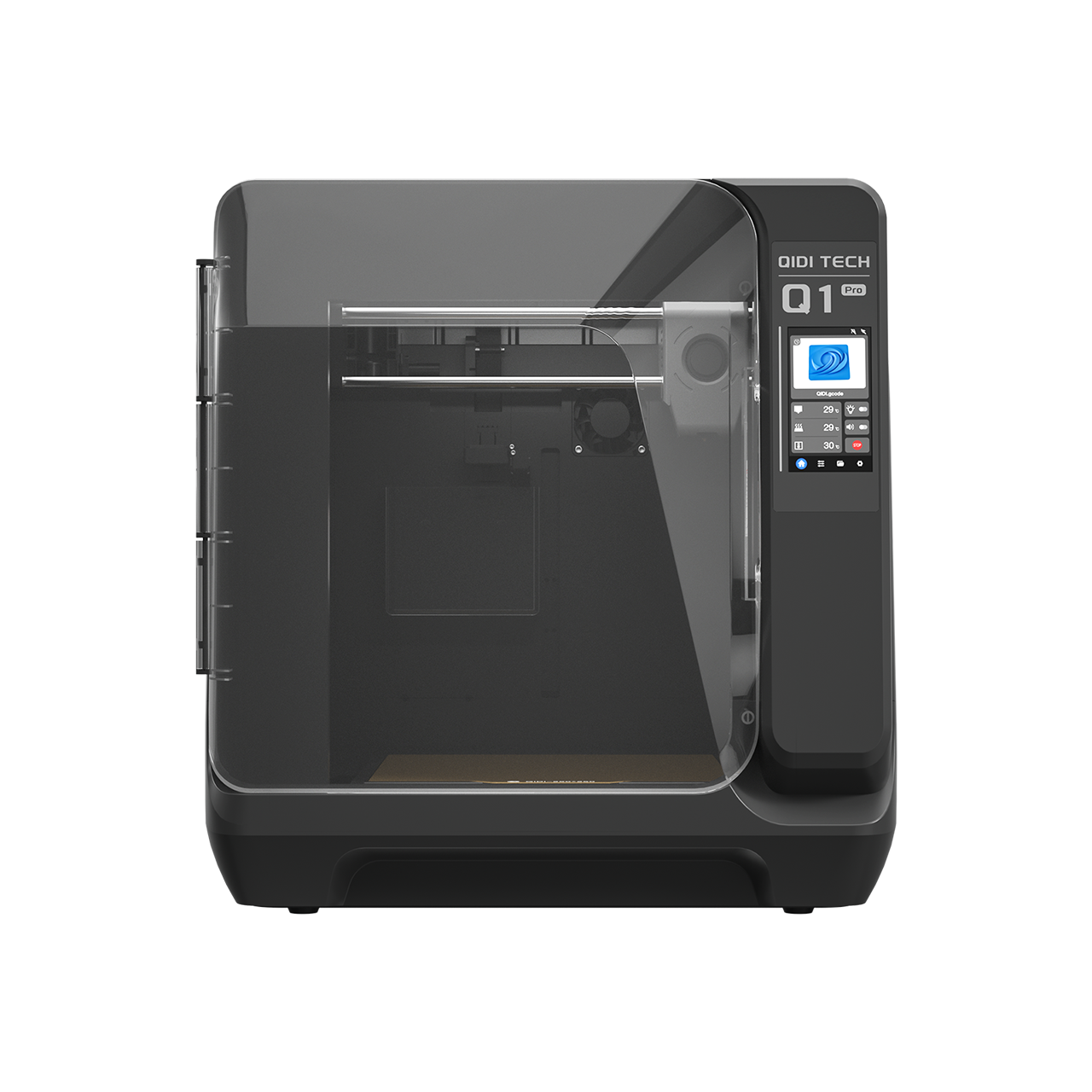
To produce functional irrigation parts that won't crack under the stress of water hammer (the pressure surge when a valve closes), you need a controlled thermal environment. The QIDI Q2 3D Printer addresses this with its active chamber heating up to 65°C. By maintaining a high ambient temperature, the printer allows the polymer chains to bond more effectively between layers, significantly increasing the Z-axis strength.
According to research published by NIST on Advanced Materials for Additive Manufacturing, maintaining consistent thermal gradients during the build process is critical for achieving the mechanical properties specified in material data sheets. Without an active chamber, your ASA connector might look perfect but fail catastrophically the first time the water pressure spikes.

Post-Processing for Molecular Bonding
Mechanical seals (threads and gaskets) are the first line of defense, but for high-stakes applications, I recommend solvent welding.
For ABS and ASA parts, a light application of acetone on the mating surfaces of a multi-part assembly creates a molecular-level bond. This isn't just "gluing" parts together; the solvent temporarily dissolves the polymer, allowing the chains to intermingle. Once the solvent evaporates, the two parts become a single, monolithic structure.
For PETG, specialized adhesives or even "annealing" (careful heat treatment) can improve watertightness, though PETG does not respond to acetone.
Field Test Performance
In our scenario modeling for small-shop irrigation setups:
- Standard FDM (No Post-Processing): Reliable up to ~15 PSI.
- FDM + Solvent Welding + 3:1 Walls: Reliable up to ~45 PSI (exceeding most residential drip systems).
Modeling Note (Scenario Analysis): These estimates assume a 0.4mm nozzle, 0.2mm layer height, and a minimum of 4 perimeters.
| Parameter | Value | Unit | Rationale |
|---|---|---|---|
| Wall Thickness | 1.2 - 1.6 | mm | 3:1 - 4:1 ratio for redundancy |
| Thread Clearance | 0.15 | mm | FDM dimensional allowance |
| Chamber Temp (ASA) | 60 - 65 | °C | Stress relief and adhesion |
| Print Speed | 60 - 100 | mm/s | Optimized for layer bond time |
| Max Test Pressure | 30 | PSI | Standard drip system limit |
The Macro View: Sustainability and Customization
The ability to 3D print irrigation components isn't just about saving a few dollars at the store; it's about the "Macro" future of distributed manufacturing and sustainable infrastructure design.
By printing your own connectors, you can:
- Reduce Waste: Create exactly what you need rather than buying "kits" with unused parts.
- Iterate Rapidly: If a specific plant bed needs a 5-way splitter that doesn't exist commercially, you can design and deploy it in four hours.
- Use Advanced Materials: Integrate high-performance polymers tailored to the specific environmental demands of your installation.
Summary of Best Practices
Reliable 3D printed irrigation is a reality if you respect the physics of the process. For those moving into professional workflows, I recommend starting with ASA Filament due to its UV stability and the use of a printer with active chamber heating like the QIDI Q2 3D Printer.
Always adhere to the 3:1 wall thickness rule and ensure a 0.15mm clearance for threaded connections. If you find yourself frequently needing to replace broken components, you might also find value in our guide on 3D printing replacement cabinet hinges, which covers similar principles of mechanical stress and durability.
The transition from hobbyist to prosumer is defined by this shift from "making it work" to "making it last." With the right materials and geometric rigor, your 3D printed garden infrastructure will be a testament to that transition.
Disclaimer: The information provided in this article is for informational and educational purposes only. 3D printed pressurized components can fail unexpectedly. Always test your components in a controlled environment before full deployment. We are not responsible for any water damage or property loss resulting from the use of 3D printed parts. Consult with a professional irrigation specialist for high-pressure or critical infrastructure installations.
- The Engineering Reality of 3D Printed Garden Infrastructure
- Material Selection: Beyond PLA
- ASA: The Outdoor Standard
- PETG Rapido: The Quick-Response Solution
- Odorless-ABS Rapido: High-Strength Functionality
- Engineering for Watertightness: The 3:1 Rule
- The 3:1 Ratio Explained
- Thread Clearance and Dimensional Variability
- Hardware Requirements: The Role of the Heated Chamber
- Post-Processing for Molecular Bonding
- Field Test Performance
- The Macro View: Sustainability and Customization
- Summary of Best Practices
Рекомендуемые продукты