
Toughness vs Rigidity: Picking the Right Filament for Hinges

Share this post
Toughness vs Rigidity: Picking the Right Filament for Hinges

The Engineering Dilemma: Why Your 3D Printed Hinges Fail

If you have ever replaced a broken kitchen cabinet hinge or a heavy toolbox latch with a 3D printed part, you have likely encountered the "Hinge Paradox." You print a part that feels rock-solid and stiff, only for it to shatter the first time the door slams. Or, you print a part that feels "tough" and flexible, only to find that within a week, the heavy lid it supports has begun to sag, leaving a permanent gap.

This frustration stems from the fundamental trade-off between toughness (the ability to absorb energy without breaking) and rigidity (the ability to resist deformation under load). In the world of prosumer 3D printing, moving from simple PLA decorative items to functional household repairs requires a shift in how we select materials. We are no longer just looking for "strength"; we are looking for specific mechanical behaviors that match the stress profile of the component.

As 3D printing integrates further into the vision of eco-friendly intelligent homes, the ability to manufacture high-performance, long-lasting spare parts on-demand becomes a cornerstone of sustainability. By understanding the material science behind hinges, we can move from temporary fixes to permanent, industrial-grade solutions.

A high-quality 3D printed heavy-duty hinge mounted on a modern wooden cabinet door, showing a clean finish and robust design.

Defining the Mechanical Balance: Toughness vs. Rigidity

To pick the right filament, we must first translate technical specifications into real-world performance.

1. Rigidity (Bending Modulus)

Rigidity is a material's "stiffness." In technical terms, we look at the Bending Modulus (measured in MPa). A high bending modulus means the material will not flex easily. This is critical for hinges that support constant weight, such as a heavy storage chest lid. If the material is too soft, it will undergo "creep"—a slow, permanent deformation under constant stress.

2. Toughness (Impact Strength & Elongation at Break)

Toughness is about energy absorption. We measure this via Impact Strength (kJ/m²) and Elongation at Break (%). A "tough" material can bend significantly before it snaps. This is vital for hinges subject to sudden forces, like a door that might be caught by the wind or a latch that is snapped shut repeatedly.

Material Deep Dive: Which Filament Wins?

Selecting the right filament is the most critical step in designing 3D printed shelf brackets or hinges for maximum load capacity.

ASA Filament: The Outdoor All-Rounder

If your hinge is destined for the garden gate or a shed, UV resistance is non-negotiable. Standard materials like ABS will become brittle and yellow under sunlight. ASA Filament is our go-to recommendation for outdoor functional parts. It offers a balanced profile of toughness and heat resistance, with a heat deflection temperature (HDT) typically above 70°C, preventing the "thermal sag" often seen in PETG or PLA parts left in the sun.

ABS-GF25: The Structural Workhorse

When rigidity is the priority, glass fiber reinforcement changes the game. ABS-GF25 Filament incorporates 25% glass fibers, which dramatically increases the bending modulus compared to standard ABS. This makes it an excellent choice for high-heat appliance mounts or heavy-duty internal hinges where you need the part to hold its shape under a constant load without bowing.

PAHT-CF (PPA-CF): The Industrial Apex

For the most demanding applications—those where professional-grade performance is required—we look toward High-Temperature Polyamide reinforced with Carbon Fiber. PAHT-CF (PPA-CF) Filament is a specialized material with a flexural modulus of approximately 6.7 GPa (6727 MPa).

The carbon fiber mesh within the polymer releases internal stress during the printing process, resulting in exceptional dimensional stability. For a maker moving into prosumer territory, PAHT-CF provides the heat resistance (up to 190°C when annealed) and stiffness required for "end-use" parts that rival injection-molded components. 

The "Perpendicular Rule" and Design Best Practices

Material choice is only half the battle. If you orient your print incorrectly, even the strongest PAHT-CF will fail.

Layer Orientation

The most common mistake is printing hinges with the layers oriented parallel to the hinge axis. This creates weak shear planes where the layers can simply peel apart. Always orient layers perpendicular to the pivot axis. This ensures that the mechanical stress is distributed along the continuous strands of extruded plastic rather than relying on the bond between layers.

Annealing for Longevity

For materials like ABS, ASA, or PAHT-CF, "annealing" is a secret weapon. Placing your printed part in a controlled heat environment (80-100°C for 4-6 hours) allows the polymer chains to reorganize and relieve internal stresses.

  • Benefit: In our experience, annealing can significantly improve creep resistance, ensuring your heavy-duty hinge doesn't sag after six months of use.
  • Warning: Be aware that some slight shrinkage (typically 1-2%) can occur during annealing. Always print a test piece if tolerances are tight for fixing door strike plates.

Hardware Matters: The Prosumer Workflow

To print these engineering-grade materials reliably, your hardware must be up to the task. Engineering filaments like PAHT-CF and ABS-GF25 require high nozzle temperatures (300°C+) and, more importantly, a stable thermal environment.

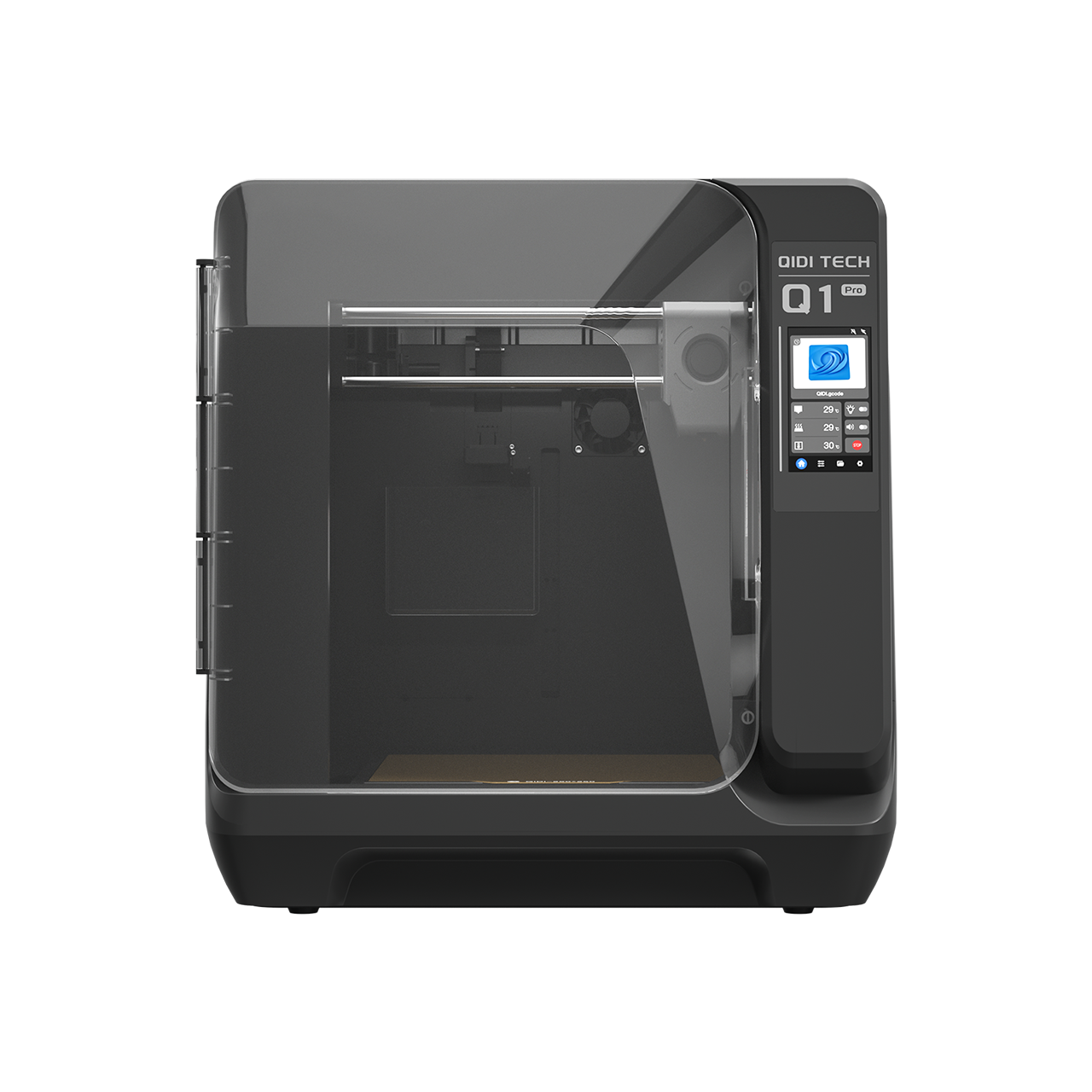
The QIDI Q2 3D Printer represents the entry point for this type of prosumer workflow. While hobbyist printers often struggle with warping when using ASA or ABS, a machine designed for these materials ensures a "perfect first layer" and the thermal consistency needed to prevent delamination. 

Summary of Key Takeaways

  • Identify the Stress: Determine if your hinge needs to resist sagging (Rigidity) or resist snapping (Toughness).
  • Choose Wisely: Use ASA for outdoor UV resistance, ABS-GF25 for high-load rigidity, and PAHT-CF for the ultimate in engineering performance.
  • Orient for Strength: Always print with layers perpendicular to the pivot axis to maximize fatigue life.
  • Post-Process: Anneal your functional parts at 80-100°C to improve long-term creep resistance and heat stability.
  • Hardware Consistency: Ensure your printer can handle the high temperatures and thermal demands of engineering filaments to reduce friction in your workflow.

By matching the mechanical properties of your filament to the specific needs of your household repair, you transform your 3D printer from a hobbyist tool into a professional-grade manufacturing station.


Disclaimer: This article is for informational purposes only. The mechanical properties mentioned are based on typical material data and may vary by manufacturer and printing conditions. Always perform your own safety tests for load-bearing components, especially in applications where failure could result in injury or property damage.

FAQ

당사의 3D 프린팅 장비와 서비스에 대한 가장 궁금한 질문에 대한 답변을 찾아보세요.

3D 프린팅은 디지털 파일로부터 3차원 물체를 제작하는 과정입니다. 플라스틱이나 금속과 같은 재료를 겹겹이 쌓아 최종 제품을 제작합니다. 이 혁신적인 기술은 맞춤형 제작과 신속한 프로토타입 제작을 가능하게 합니다.

저희는 모든 제품에 대해 빠르고 안정적인 배송 옵션을 제공합니다. 주문이 접수되면 배송 진행 상황을 확인할 수 있는 추적 번호를 보내드립니다. 배송 시간은 지역에 따라 달라질 수 있습니다.

저희 3D 프린터는 제조 결함에 대한 1년 보증을 제공합니다. 연장 보증 옵션을 구매하실 수 있습니다. 자세한 내용은 보증 정책을 참조하세요.

네, 저희는 번거로움 없는 반품 정책을 시행하고 있습니다. 구매하신 상품에 만족하지 못하시면 30일 이내에 반품하시면 전액 환불해 드립니다. 상품이 원래 상태 그대로인지 확인해 주세요.

물론입니다! 저희 전담 지원팀이 모든 질문과 문제를 도와드립니다. 이메일이나 전화로 연락하시면 신속한 지원을 받으실 수 있습니다. 또한, 다양한 정보를 제공하는 온라인 리소스 센터도 운영하고 있습니다.

여전히 질문이 있습니까?

문의사항이 있으시면 언제든지 연락주세요.