
 Q2
Q2
 QIDI Box
 Plus 4
 Q1 Pro
 X-Max 3


3D Printer Size: Are You Paying for Volume You'll Never Use?

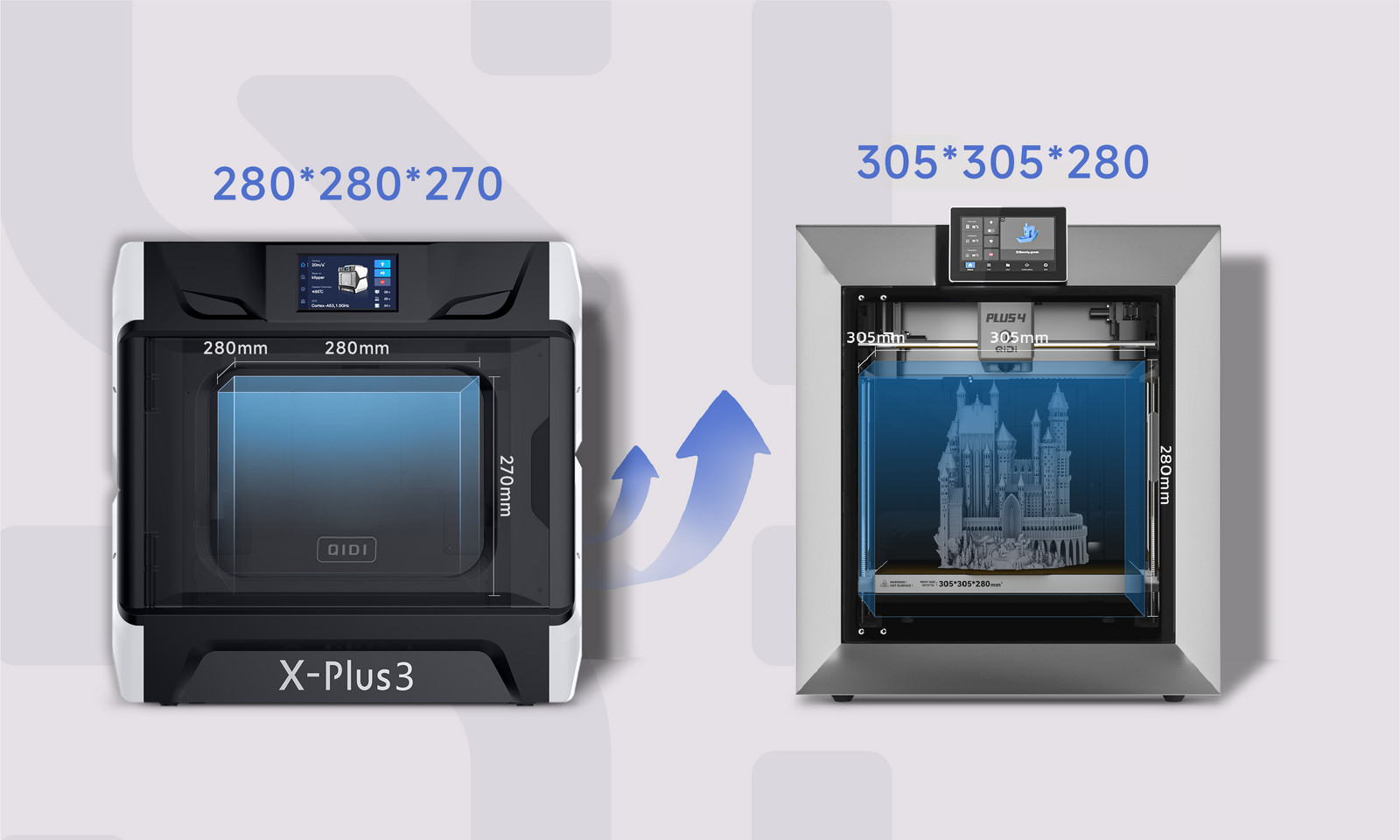
For most people, a standard-sized 3D printer with a build volume between roughly 220 × 220 × 250 mm and 305 × 305 × 280 mm is the right choice. A large-format machine costs more to buy, occupies more bench space, draws more power, and makes every failed print more expensive. Buy for the parts you actually make, not the one giant project you might attempt.
Many new owners end up in the same situation: they pay a premium for a machine with a massive build area, then spend a year printing objects that use a fraction of it. That huge printer, bought for ambitious "what-if" projects, sits idle taking up valuable desk space. The appeal of a large build volume is often a trap. For day-to-day work, a standard-sized machine is not a compromise; it's the more practical, efficient, and economical tool.
Build Volume Classes at a Glance
| Class | Typical build volume | Best for | Main drawback |
|---|---|---|---|
| Compact | 150 × 150 × 150 mm to 200 × 200 × 200 mm | Miniatures, small functional parts, classroom use | Runs out of room on anything the size of a helmet section |
| Standard | 220 × 220 × 250 mm to 305 × 305 × 280 mm | The great majority of hobby and functional printing | Large models must be split and joined |
| Large format | 350 mm and above per axis | Single-piece props, full-scale prototypes, batch plates | Higher price, larger footprint, slower heat-up, costlier failures |
The Full Cost of a Large Printer: More Than the Price Tag
A large-format printer is appealing, but its total cost goes far beyond the purchase price. You also pay for the physical space it occupies, the electricity it consumes, and its ongoing maintenance.

Higher Initial Purchase Price
As a general rule, the larger the build volume, the higher the upfront cost. Within a single manufacturer's lineup the jump is easy to see: QIDI's standard-sized Q2 is $499 at 270 × 270 × 256 mm, while the large-format Max4 is $1,049 at 390 × 390 × 340 mm — roughly double the price for about 2.4× the volume.
That difference isn't arbitrary; it comes from manufacturing cost. To handle the increased scale and stay rigid, larger printers need thicker frames, longer belts, more powerful electronics, and bigger mechanical parts, all of which raise the final price.
Hidden Costs of Operation and Maintenance
The expenses continue long after the initial purchase:
- Physical Footprint: Large printers take up much more room. The frame and enclosure are always considerably larger than the print bed itself, so a large-format machine can consume an entire workbench. You need a dedicated space for it.
- Power Consumption: Heating a bigger print bed takes substantially more energy, which means longer heat-up times before a print starts and a higher share of your electricity bill over a year. Our cost-per-hour breakdown puts real numbers on this.
- Maintenance and Parts: Consumables scale with the bed. A replacement flexible build sheet for a 390 mm bed costs more than one for a standard-sized printer, and you'll replace it just as often.
- Cost of Failure: A failed print always stings, but it's a much bigger loss on a large machine. A print that fails after 40 hours wastes far more time and filament than a 6-hour print failing. With every large job, the stakes are higher.
Combined, these factors show that the true investment in a large printer goes well beyond its sticker price. That commitment of money, space, and time should be weighed against your actual printing needs.
Why a Smaller Printer is Often the Smarter Choice
Huge printers have their place, but a standard-sized machine covers more ground than most buyers expect. It comes down to buying a 3D printer for the things you'll actually make, not for the one giant project you might try later.
The 80/20 Rule of Printing
Most of what you'll print — repair parts, brackets, gadgets, gaming miniatures, enclosures — fits comfortably on a standard plate. There's a reason this size became the default: it's big enough for almost everything, without the drawbacks of a giant machine.
A Surprising Edge in Quality
Here's what surprises people: smaller printers often produce cleaner prints. Shorter belts and a tighter frame mean less resonance when the toolhead changes direction quickly. Less vibration means sharper corners and fewer ringing artefacts, especially at high speed. Firmware compensation such as input shaping narrows the gap, but it doesn't erase the physics.
Quicker, More Reliable, and Cheaper to Run
A smaller print bed heats faster and uses less power — good for your patience and your electricity bill. The mechanics are simpler too. With less mass to accelerate, there's less wear on belts and motors, which generally means fewer failures and less maintenance.
The Secret to Printing Big: Go Small
So how do you make that huge cosplay helmet on a standard printer? You print it in pieces. Using a technique called "splitting," you slice a large model into manageable parts right in your slicer. This has real advantages:
- Less Risk: If one piece fails, you've lost a few hours of material, not a whole weekend.
- More Options: You can print different pieces in different colours or materials — a rigid shell with flexible TPU grips, for instance.
- Better Strength: You can orient each piece so the layer lines run against the load, which you often can't do when printing an object whole.
Once everything is printed, you join the parts. Alignment pins plus cyanoacrylate glue or two-part epoxy give a strong bond, and plastic "welding" with a rotary tool or a soldering iron can make the seam nearly invisible after sanding.
When a Large Printer Is the Right Choice
While standard printers handle most jobs, some projects genuinely require a large-format machine. A large printer is a good investment when you have a specific, recurring need for its capabilities.

Projects That Require a Large Build Volume
Some applications are difficult or impossible without a large, uninterrupted build area:
- Cosplay and Props: Full-sized helmets and large props are often printed in one piece for strength and a seamless finish.
- Full-Scale Prototypes: Engineers and designers frequently need single-piece prototypes — drone bodies, equipment enclosures — to test form and fit accurately.
- Art and Architectural Models: Sculptures and detailed building models often depend on scale for their visual impact. Additive manufacturing research increasingly targets exactly this large-part regime.
- Batch Production: A large bed lets you print many copies of a small item at once. For bulk parts, though, several smaller printers running as a "print farm" are often more efficient and more resilient than one big machine.
Key Benefits of Single-Piece Printing
When your project genuinely calls for it, printing in one piece offers clear advantages over assembly:
- Greater Strength: Single-piece objects have no glued seams to become weak points under load.
- Better Appearance: The surface is cleaner, with no seam lines to hide or sand down.
- Faster Post-Processing: You skip the assembling, gluing, and filling steps entirely.
If your primary work falls into these categories, the trade-offs in cost and space become worthwhile for the results you get.
The Industry Standard: Printers in the 220–305 mm Range
For most users, a standard-sized printer is the best choice: a build volume from about 220 × 220 × 250 mm up to roughly 305 × 305 × 280 mm. This range became the default not by accident, but because it offers the most practical combination of capability and cost.
It's the Right Functional Balance
A standard build plate is large enough for impressive, large-scale projects — printed in a few manageable parts — while staying efficient and economical for the small functional prints you'll do every week. You get most of the capability without the footprint and power draw of a large machine.
It Has the Best Ecosystem
Because this is the most common size, it has the most support: more competition on price, a larger selection of upgrades and spare parts, and a much bigger online community. When something goes wrong or you want to modify your machine, tutorials for a standard-sized printer are everywhere. The open hardware community has been iterating on this class for over a decade.
Frequently Asked Questions
What is a good build volume for a first 3D printer?
Around 250 × 250 × 250 mm. It fits nearly every beginner project, heats up quickly, and keeps the machine small enough to sit on a normal desk. QIDI's Q2 and Q2C sit just above that at 270 × 270 × 256 mm.
Does a bigger 3D printer print more slowly?
Not per layer, but a large machine takes longer to reach temperature, and a larger moving mass usually forces lower acceleration limits to keep quality. The bed heat-up penalty alone can add several minutes to every job.
Can I print a helmet on a standard-sized printer?
Yes. Split the model into two to four sections in your slicer, print each in the orientation that gives the best surface and strength, then join with alignment pins and epoxy. Most published cosplay models are already sectioned for exactly this.
Is it cheaper to buy one large printer or two standard ones?
Two standard printers usually cost about the same as one large-format machine and give you twice the throughput plus redundancy. The large machine only wins when a part physically cannot be split.
Calibrate Your Decision Before You Calibrate a Printer
Base your printer choice on real projects, not hypotheticals, so you don't pay for build volume you never use. Before buying, assess the parts you're likely to print, the bench space you have, and whether you're willing to split large models. A standard-sized printer is the wisest starting point for almost everyone. It handles most jobs well, and you can always add a large-format machine later if a genuine need appears.
- Build Volume Classes at a Glance
- The Full Cost of a Large Printer: More Than the Price Tag
- Higher Initial Purchase Price
- Hidden Costs of Operation and Maintenance
- Why a Smaller Printer is Often the Smarter Choice
- The 80/20 Rule of Printing
- A Surprising Edge in Quality
- Quicker, More Reliable, and Cheaper to Run
- The Secret to Printing Big: Go Small
- When a Large Printer Is the Right Choice
- Projects That Require a Large Build Volume
- Key Benefits of Single-Piece Printing
- The Industry Standard: Printers in the 220–305 mm Range
- It's the Right Functional Balance
- It Has the Best Ecosystem
- Frequently Asked Questions
- What is a good build volume for a first 3D printer?
- Does a bigger 3D printer print more slowly?
- Can I print a helmet on a standard-sized printer?
- Is it cheaper to buy one large printer or two standard ones?
- Calibrate Your Decision Before You Calibrate a Printer
Recommended products